How Does Early Education and Care in the U.S. Stack up to Other Developed Countries?

 For obvious reasons, this blog focuses primarily on early education policy issues in the United States. But sometimes taking a step back and looking at early education in other developed countries can offer a useful perspective on our own early education challenges.
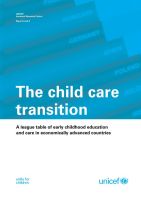
That’s why a recent report from UNICEF’s Innocenti Research Center is particularly valuable for individuals working on early education policy issues. The report postulates that the developed world is undergoing a transition in how we care for an educate young children. Due to a combination of economic and social changes that have increased mother’s participation in the workforce, and growing awareness of the importance of children’s early years for long-term development and learning, young children in OECD countries are spending amounts of time in organized child care settings. In the words of the report, “Today’s rising generation in the countries of the OECD is the first in which a majority are spending a large part of their early childhoods not in their own homes with their own families but in some form of child care.”
The report’s authors, rightly, recognize this transition as both a potential opportunity to improve child development and early learning–particularly for disadvantaged children whose homes may not provide sufficient support for early learning–and also a risky time, with potential for children to be harmed if policymakers don’t make thoughtful choices to support families in this transition.
To provide information about the child care transition, and to help policymakers make wise choices about it, the Innocenti Research Center has developed a list of 10 benchmarks against which countries can measure how they are doing in early care and education. These benchmarks include:
- Parental leave of 1 year at 50 percent of salary
- A national plan with priority for the disadvantaged
- Subsidized and regulated child care services for 25 percent of children under 3
- Subsidized and accredited early education services for 80 percent of 4-year-olds
- 80 percent of all child care staff trained
- 50 percent of all staff in accredited early education services with tertiary education and relevant qualification
- Minimum staff-to-child ratio of 1:15 in pre-school education
- 1 percent of GDP spent on early childhood services
- Child poverty rate less than 10%
- Near-universal outreach of essential child health services
How does the United States stack up on these indicators? We achieve only three of the 10 benchmarks (Subsidized child care for 25 percent of children under 3, 50 percent of staff in accredited early education centers with tertiary degrees, and minimum staff: child ratio of 1:15) and rank below 18 out of 25 OECD countries. While the United States compares pretty well with other OECD countries on benchmarks of child care and early education access and some quality measures, we fall short on others–particularly access to paid parental leave, where we are one of only two OCED countries to provide no paid parental leave at all (Australia is the other). And because of the lack of parental leave, the United States actually has a higher percentage of 0-3 year-olds in child care than all but four OECD countries.
In addition to listing and ranking countries against these benchmarks, the UNICEF report provides a useful overview of the policy questions and challenges nations and states face in building systems and policies to respond to the child care transition. These include:
- Parental leave
- Whether the goals of early education and care should be defined as school readiness or broader cognitive and social development
- Whether early care and education services should be universally available, targeted to disadvantaged children, or some hybrid of the two
- The extent to which the delivery system for care and education should incorporate diverse providers
- Access
- Defining quality in early care and education; and
- The amount of resources states should devote to subsidizing early care and education.
These topics will sound strikingly familiar to anyone involved in early education and care issues in the United States, and the report’s analysis of them in international context provides useful perspective for debates here at home.
Despite the significance and quality of this report, it’s gotten relatively little attention here in the United States. That’s a striking contrast to both how the U.S. media greeted last week’s announcement of TIMSS results comparing U.S. 4th and 8th graders to their international peers in math and science (note: we’re actually doing pretty well!), and how some other OECD countries are greeting this UNICEF report. When we were in Finland recently, the Finnish early childhood experts and officials we met with there were quite concerned about the fact that Finland scored only 8 out of 10 on the report’s benchmarks, even though the two areas in which Finland didn’t meet benchmarks reflect reasonable policy decisions that I don’t think, in context, actually reflect negatively on how Finland cares for and educates its youngsters. In contrast, the United States’ poor showing on these benchmarks does reflect some ways in which we are falling short in meeting the needs of our youngest children in their families. But I’ve seen not a word about it since coming home. U.S. early childhood advocates and policymakers take note: This is an important report, and you’d do well to pay attention to it!
More About the Author
Issues
Programs/Projects/Initiatives
Related

Five Things Principals Can Do to Protect Kindergarten’s Three Indispensables

Federal Early Education Update: September 2026

Five Things States Can Do to Support High-Quality Kindergarten and the Early Grades