Final Stimulus Agreement Emerges

After much deliberation, the Senate and House of Representatives have come to an agreement on a conference report of the stimulus bill. If the conference report passes in both houses, the bill will go to the president for his signature. As we described in previous posts, there were many significant differences between the versions passed originally by the House and Senate. In the majority of cases, the conference report represents a compromise between the two bills, particularly as it concerns the Fiscal Stabilization Fund – a new fund to help states maintain funding for education and other services.
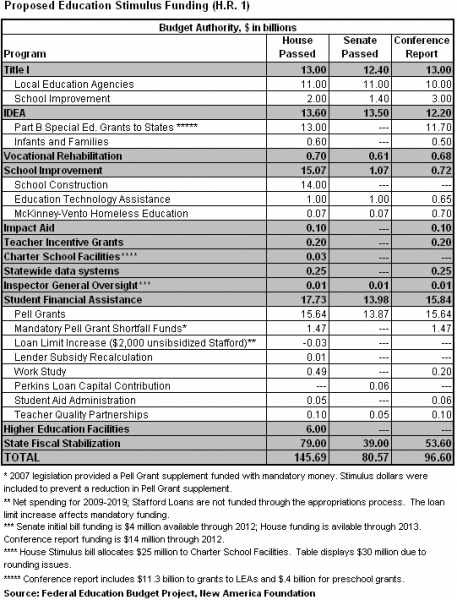
The conference report funds the State Fiscal Stabilization Fund at $53.6 billion for the purpose of filling the gap between 2006 and 2008 or 2009 elementary, secondary, and post-secondary funding levels in fiscal years 2009, 2010, and 2011. It includes a maintenance of effort provision requiring states to maintain 2006 funding levels for K-16 education in order to receive funding. These funds are to be distributed to states based on school age and total population.
Previous versions of the Stabilization Fund only provided funds to help states maintain education funding at 2008 budget levels for fiscal years 2009 and 2010. The conference report allows states to use Stabilization Funds to maintain the greater of 2008 or 2009 funding levels in 2009, 2010, and 2011.
Of that $53.6 billion, $43.84 billion (81.8 percent) must go to preK-16 education purposes authorized under No Child Left Behind, IDEA, the Adult and Family Literacy Act, or the Perkins Vocational and Technical Act. This amount is higher than the amounts allocated in either the adopted House or Senate bills specifically for education purposes.
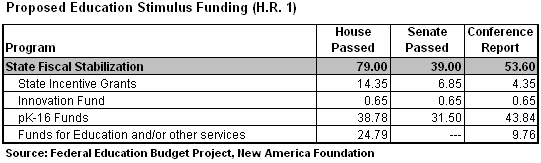
One of the largest compromises between the House and Senate adopted bills is in the $9.76 billion of the Stabilization Fund allocated for education, public safety, and other government services. Specifically, this money can also be used for remodeling and renovation for public schools and private or public institutions of higher education. While the House bill allocated $20 billion for both K-12 and higher ed construction as a separate pot of funding, the adopted Senate bill allocated nothing. Including remodeling and renovation funds in the Fiscal Stabilization Fund allows states to use that money for other purposes if they so choose. These funds cannot be used for new construction.
State Incentive Grants and the Innovation Fund are also included in the conference report version of the Stabilization Fund. However, the two programs are slated to receive $4.35 billion and $650 million, respectively. This is a significant drop for the State Incentive Grant program (from $14.35 in the House bill and $6.85 in the Senate bill). Funding for the Innovation Fund was unchanged in the conference report.
Other compromises include allocations for Title I and Individuals with Disabilities Education Act (IDEA). Although the adopted Senate bill provided $12.4 billion for Title I, the conference report provides $13 billion with $10 billion for grants to local education agencies (LEAs) and $3 billion for School Improvement grants. This represents a larger allocation for School Improvement grants than either the House ($2 billion) or Senate ($1.4 billion) adopted bills provided.
The conference report allocation for IDEA also differs from the House and Senate adopted bills. Total funding is $12.2 billion with $11.2 billion for Grants to States, $400 million for preschool grants, and $500 million for Infant and Family Grants. Although the adopted Senate bill provided 15 percent of its IDEA funds for preschool grants, the adopted House bill did not include any specified funds for preschool.
The conference report also includes funding for several smaller programs that were included in the House adopted bill but not the Senate’s. This includes $100 million for Impact Aid, $200 for Teacher Incentive Grants, $250 million for Statewide Data Systems, and $200 million for Federal Work Study. The conference report also includes the allocations for Pell Grants ($15.64 billion) and the Mandatory Pell Grant Shortfall Fund ($1.47 billion) as the House adopted bill.
Other notable changes include an increase in the maximum total value of federal tax credit bonds for school construction (Qualified School Construction Bonds). Although the adopted Senate and House versions limited the face value of these bonds to $5 billion total in both 2009 and 2010, the conference report allows a limit of $11 billion in both 2009 and 2010. The increase in total value for issued Qualified Zone Academy Bonds (for charter schools) was unchanged at $1.4 billion for 2009 and 2010.
Both the House and the Senate are expected to vote on the conference report either today or sometime this weekend. At that rate, the bill could land on President Obama’s desk sometime next week. But much more work behind the scenes will have to be done to ensure the speedy distribution of all of those dollars.
More About the Authors
Issues
Related

Community College Presidents and Trustees Invited to Complete National Survey on Economic Development
Public Comments on DOL’s Independent Contractor Rule

Unraveling the Case for Credentials in High School