A Closer Look at the Stimulus Bill

Text of the Conference Report on the stimulus bill is now available on the House Rules Committee website (warning: these are very large files). The House and Senate are voting on the legislation today. Early Ed Watch read through the bill and took a closer look at the funding levels the bill provides for various early education programs:
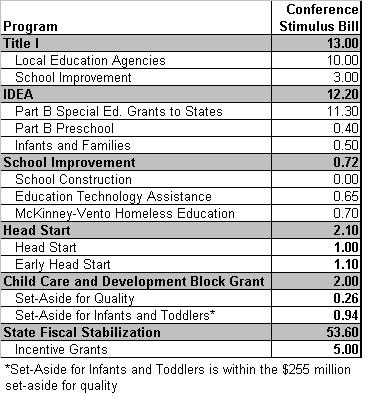
Early education advocates are pleased that the conference committee restored Head Start funding in the bill to the $2.1 billion level in the House version, up from the $1.05 provided for Head Start in the Senate bill. But they should actually be pretty disappointed with the conference committee. While the Senate’s version of the bill would have set-aside 15 percent of new IDEA and Title I funds for programs to serve preschool-aged students, the conference committee dropped that provision from the bill. Had the provision remained in the bill, that would have meant nearly $2.3 billion more in funding for early education programs than the conference bill provides. The early education funds lost because the conference committee dropped the 15 percent set-aside of Title I and IDEA funds for preschool-aged children from the Senate’s bill outweigh the gains from restoring Head Start funding to the House level.
In our view, this most important part of this bill for early education has always been the State Fiscal Stabilization component, because state fiscal aid can help reduce the need for state-level budget cuts that could potentially decimate state investments in early education services, as well as the emerging infrastrucutre to support them. The conference committee did restore some state fiscal stabilization funding that was cut in the Senate’s bill, although not to the levels in the House bill. Moreover, we have some concerns about how that $53.6 billion in state fiscal stabilization aid will be spent. The bill allocates the lion’s share of that money–81 percent–to support “elementary, secondary, and postsecondary education and, as applicable, early childhood education programs and services.” So, they included early childhood in programs for which these funds can be used–good. But the bill then specifies that governors must use these funds for two purposes: First, restoring state education aid to school districts provided through the state’s school funding formula to 2008 or 2009 levels; Second, restoring state aid to public institutions of higher education to 2008 or 2009 levels. If money remains after states have done both these things, they must allocate it to school districts in accordance with the Title I funding formula. No mention of using these funds to maintain state pre-k or other early childhood funding–a huge ommission.
Now, nine states do fund pre-k programs through the state school funding formula–and this is yet another example of why we think that’s ultimately the right way to fund pre-k programs. And the bill does allow governors to use 18.2 percent of their state fiscal stabilization funds to support other government services–funding which they could (and, we’d argue, should) use to maintain support for state pre-k and other early childhood investments. But early childhood will have lots of competition for those funds. Early education advocates in the states must swing into action now to ensure that their governors use those funds to maintain early childhood investments.
Still, there’s much to celebrate in this bill. The $53.6 billion in State Fiscal Stabilization aid will help governors in states that have prioritized early childhood to continue to invest in these programs. The $2 billion in additional CCDBG funding will support job creation by making child care available to low-income and working-class families who need it to work. The $2.1 billion in Head Start funding will enable providers to improve the quality of Head Start programs, and states to better coordinate early childhood programs, while also expanding access to Early Head Start.
There are also things to be disappointed about. Congress could have used this opportunity to make significant new investments in school district and community-based early childhood facilities, improving access to quality early education while also creating new construction jobs. They didn’t do that. They could have ensured that the State Fiscal Stabilization fund protect state early childhood investments from the budget chopping block. They didn’t do that. And they could have provided more resources to help school districts close achievement gaps when the begin–in the preschool years–rather than waiting until kindergarten. They didn’t do that.
But perhaps best thing about it the stimulus bill is something else that Congress didn’t do: They didn’t rush into making large, poorly thought-out new investments in expanding early childhood programs, which would have likely resulted in lower-quality and poorly managed programs.
The federal government should play a more aggressive role in supporting access to quality, aligned early education programs. But the stimulus was not the place for that, and given that, the overall results are probably about as good as early education supporters should have hoped for. This is not the only chance for new early education investments this Congress. There will be time in the future for more ambitious early education proposals.
More About the Author
Issues
Programs/Projects/Initiatives
Related

Five Things Principals Can Do to Protect Kindergarten’s Three Indispensables
Federal Early Education Update: September 2026

Five Things States Can Do to Support High-Quality Kindergarten and the Early Grades