Final Education Stimulus Distributions to the States

Over the weekend, Congress passed the much anticipated 2009 stimulus bill. Once the president signs the bill, the Department of Education will begin the process of distributing the over $90 billion in education funds. In the end, the amount each state will receive is only slightly less than what was allocated in the House adopted bills. Some states fare quite well and can expect a rather large infusion of funds (DC, Louisiana, Wyoming), while others will have to make do with considerably less (Utah, Mississippi). As was expected, the distribution of funds is skewed by the existing Title I formulas.
To help shine a light on the distribution process, the House Education and Labor Committee has released state and district level estimates of stimulus dollar distributions for the major programs listed in the stimulus bill. The Committee’s estimates are based on CRS calculations of 2009 allocations to states and districts for Title I Grants to local education agencies (LEAs), Title I School Improvement Grants, Title II Education Technology Grants, McKinney Vento Homeless Assistance, IDEA Part B, IDEA Part C, and the State Fiscal Stabilization Fund (for all years).
We used these estimates to examine total stimulus dollars per student and Title I dollars per poor student in the 50 states, DC, and Puerto Rico. The story is not much different from previous analyses of the House adopted version of the bill.
First we examined total stimulus dollars in 2009 without including funds from the State Fiscal Stabilization Fund. According to our analyses, the District of Columbia will receive the most stimulus dollars per student in 2009 – $1,152. Puerto Rico will receive the second most at $745 per student, and Louisiana will receive the third most at $740. The District of Columbia and Louisiana rank second and third, after Mississippi, in terms of students living in poverty. Mississippi is slated to receive $616 per student, ranking 13th.
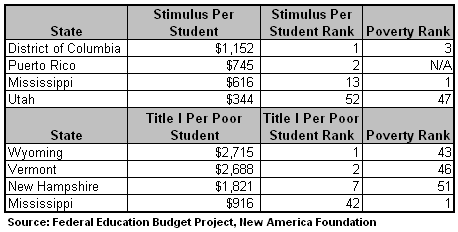
In contrast, Utah is expected to receive the least in total stimulus dollars at $344 per student. Utah ranks 47th in terms of students living in poverty (10.2 percent). New Hampshire, which has the lowest percentage of students living in poverty, will receive $456 per student, ranking 42nd.
When we included the State Fiscal Stabilization Fund in our total stimulus dollars per student calculation, the story changed slightly. The State Fiscal Stabilization Fund consists of a State Incentive Grant Program, an Innovation Fund, and a general fund to be used to help states maintain 2008 levels of education funding. Although DC is expected to receive the most stimulus dollars per student ($2,658), Delaware is expected to receive the second most at $1,944 per student, displacing Puerto Rico which ranks 23rd with the inclusion of the Stabilization Fund. Several other states receive large increases in per student funding with the addition of the Stabilization Fund. Arizona jumps from 37th to 24th, Hawaii from 32nd to 20th, and Maryland moves from 41st to 31st in terms of per student stimulus funding. Utah is still expected to receive the least per student ($1,289).
This reshuffling of state ranking in terms of per pupil stimulus spending can be attributed to the way the State Fiscal Stabilization Fund is distributed. Rather than relying on existing Title I formulas to distribute these dollars, the stimulus bill allocates the Stabilization Fund based on a calculation that combines total student population (age 5-24) and total population (all ages). As a result, the per student allocation of the Stabilization Fund is relatively similar among states.
As we discussed previously, Title I formulas take into account other factors beyond number or percent of students living in poverty. The formulas consider state size, state effort (proportion of total state budget dedicated to education), and state funding equity (degree to which the state funds each district equitably). These factors skew the distribution of Title I funds, lessening the degree to which states with larger poor populations receive more funds per student.
Finally, we examined the distribution of 2009 Title I stimulus dollars per poor student. As in our previous analysis, Wyoming is expected to receive the most funds per poor student at $2,715 even though it ranks 43rd in terms of students in poverty. Vermont will receive the second most at $2,688 per poor student. Vermont ranks 46th in terms of poverty. Utah will receive the least per poor student ($780) and ranks 46th in poverty.
Mississippi, which has the highest percentage of students living in poverty, will receive $916 per poor student, ranking 42nd in stimulus dollars per pupil. New Hampshire, the least impoverished state, will receive $1,821 per poor student, ranking 7th.
The stimulus bill is expected to provide a short term boost to our economy, while building the capacity for states and districts’ to properly fund education. Given the economic, rather than social, motivations of the stimulus, it is unsurprising that there is little relationship between poverty and the distribution of stimulus dollars. However, one of the programs the stimulus funds, Title I, has a mission that is inherently linked to poverty. Until the Title I formulas are altered to better reflect the percent of students living in poverty, Title I’s goals may continue to go unaddressed.
A spreadsheet containing this information for all 50 states, DC, and Puerto Rico can be downloaded here.
More About the Authors
Issues
Related

Community College Presidents and Trustees Invited to Complete National Survey on Economic Development
Public Comments on DOL’s Independent Contractor Rule

Unraveling the Case for Credentials in High School