Jason Delisle
Director, Federal Education Budget Project

Pell Grants for the 2009-10 school year have become a budget nightmare. The program has always had its budgeting quirks, but this year is shaping up to be the most complicated and confusing of all. New funding streams, unfinished 2009 appropriations bills, stopgap funding measures, shortfalls, and now a stimulus bill have created one ugly Pell Grant budget. We’ll try to sort out the factors that play into the 2009-10 grant.
The Pell Grant program is the cornerstone of federal grant aid for low-income college students. This academic year, low-income students will receive Pell Grants worth between $890 and $4,731 each to pay for tuition and other attendance related costs. When determining Pell Grant appropriations, Congress sets a maximum grant level for the year and provides what it estimates to be the necessary funding. Each student’s grant amount is determined by a formula based on his or her financial need.
The Shortfall and Temporary Fix
Last fall, a few news sources reported that 2008-09 Pell Grant funding might run out before students received all of the aid for which they were eligible. This problem was caused by a “shortfall.” Congress had not set aside enough funding to pay for all of the grants awarded in the 2007-08 school year because the number of awards exceeded expectations. (2008-09 grants are expected to be underfunded as well.) To ensure student grants were not reduced, the U.S. Department of Education followed common practice and dipped into funding already set aside for the following year (2008-09 grants) in fiscal year 2008 appropriations. (See the Federal Education Budget Project resource page for more on this issue).
By the time the Department of Education distributed 2008-09 Pell Grants last fall, it expected to be about $2 billion short. This is because some of the money Congress set aside for them had already been used to make 2007-08 grants, and the 2008-09 grant was also underfunded. This “borrowed” money and underfunding usually doesn’t affect student grants because budget rules require Congress to make up for them when it funds Pell Grants for the next year. But Congress has not yet filled the most recent shortfall because it postponed education appropriations, and therefore Pell Grant appropriations, for fiscal year 2009 (which began Oct. 1, 2008).
In place of fiscal year 2009 appropriations, Congress enacted a stopgap funding measure last fall. The measure gives the Department of Education spending authority to compensate for any grant reduction for students that might otherwise result from the missing $2 billion. When this authority expires on March 6th, the $2 billion shortfall will come back…except the stimulus should provide enough funds to retire the shortfall.
Stimulus, Pell, and the Shortfall Fix
Congress increased the maximum 2009-10 Pell Grant level by $500 from $4,360 in the stimulus bill enacted earlier this month. Although the $4,360 base level has not actually been set in law yet, an explanatory statement accompanying the bill suggests that fiscal year 2009 appropriations considered later this year will fund at that level. The stimulus appropriates more funding ($15.6 billion) than is necessary to fund the $500 increase for 2009-10, which by default, will be used to retire the $2 billion shortfall from the prior year.
New Mandatory Funding Problems
While the Pell Grant program has experienced shortfall problems in the past, an entirely new funding problem has now emerged with the 2009-10 grant. In 2007 Congress created a new 10-year funding stream for Pell Grants separate from the annual appropriations funding (i.e. mandatory funding). These mandatory funds provide an equal “add-on” to each student’s Pell Grant. For academic years 2008-09 and 2009-10, the law states that the add-on must be $490 for every student who receives a Pell Grant.
The Department of Education reported last fall, however, that the available $2.1 billion in mandatory money was not enough to support $490 because more students were eligible for grants than Congress expected in 2007. Instead, it might need to use its authority to reduce the 2009-10 add-on to $400.
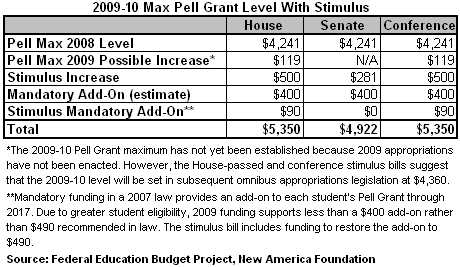
The $500 stimulus funding increase compounds the shortfall in the mandatory funding stream. This increase makes 800,000 more students eligible for grants than were previously, according to the House Appropriations Committee. Pell Grants are awarded on a sliding scale, and when the maximum grant is increased, the sliding scale expands and captures more students, awarding them a minimum grant.
As a result of the expanded eligible student population, the separate mandatory add-on now must be spread among more students, reducing its value for all recipients. The stimulus, however, also adds $643 million to the already available $2.1 billion in mandatory funds to restore the add-on to $490 per student.
Putting It All Together
In sum, students attending school in fall 2009 look set to receive bigger Pell Grants. Students with the most need will get as much as $5,350, compared to $4,731 in school year 2008-09. Adding up all the moving pieces to arrive at this figure is a daunting task. Ed Money Watch will keep you posted on any future developments that will affect the 2009-10 Pell Grant.
Director, Federal Education Budget Project