Education Funding in the 2009 Omnibus Appropriations Bill

Yesterday, the House of Representatives and the Senate Appropriations Committees released the text of the 2009 Omnibus bill. This bill dictates appropriations for fiscal year 2009, which started on October 1st, 2008. In the majority of cases, the 2009 Omnibus increased program funding from the 2008 level. The total Department of Education appropriation is $66.5 billion, up from $62.1 billion in fiscal year 2008.
Typically, the annual appropriations process begins after Congress adopts a budget resolution, usually by late spring. Congress adopted a budget resolution for fiscal year 2009 in May 2008. Although the Appropriations Committees in both the House and Senate took up the Labor, HHS, and Education Appropriations bills in June, neither chamber adopted a bill. Eventually, majorities in both Houses opted to postpone consideration of all 2009 appropriations, except Homeland Security, until after the elections. (For a timeline of events surrounding 2009 appropriations, please see here.)
Given the delay in the process last fall, it is no surprise that the 2009 appropriations are now being conducted through an Omnibus bill. Appropriations bills are usually broken into 12 jurisdictional areas each encompassed by a separate appropriations subcommittee such as the Labor, HHS, and Education Appropriations Subcommittee. But considering each bill individually is a cumbersome political process. As a result, Congress has recently gotten into the habit of lumping several, if not all 12, individual appropriations bills into one bill that is considered as a single piece of legislation. This is called an Omnibus.
The 2009 Omnibus bill determines line-by-line appropriations for every education-related program including the No Child Left Behind (NCLB) Act, the Individuals with Disabilities Education Act (IDEA), student financial aid, higher education, and the Institute for Education Sciences (IES). A table detailing these appropriations for major programs can be found below.
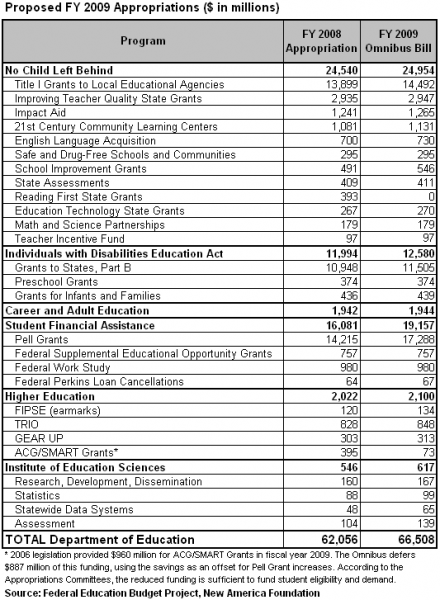
Programs that received major increases in funding from 2008 to the 2009 Omnibus appropriation include NCLB Title I Grants to Local Education Agencies (LEAs) ($594 million), IDEA Grants to States Part B ($561 million), Pell Grants ($3.1 billion), and Assessment under IES ($35 million).
A few programs had their funding reduced in the fiscal year 2009 Omnibus. These include Reading First State Grants, for which all funding was cut in 2009, and ACG/SMART Grants, for which funding was cut by $322 million due to a budgeting quirk. The Appropriations Committees justified cutting Reading First funding due to a recent study that found that the program had no significant positive impact on reading. ACG/SMART Grants lost funding in 2009 because remaining money from earlier appropriations is expected to be sufficient to meet demand for the program in 2009.
Now that both Appropriations Committees have released the Omnibus bill, it must be approved by both Houses. It appears that both the House and Senate are poised to pass identical Appropriations bills, making the conference committee process unnecessary. This is good because the current Continuing Resolution (CR) which temporarily provided funding for fiscal year 2009 expires on March 6th, meaning that the Omnibus bill must be signed by the President before then.
More About the Authors
Issues
Related

Scrolling to Financial Agency: How Gen Z Navigates Financial Advice on Social Media

From Momentum to Maturity

Community College Presidents and Trustees Invited to Complete National Survey on Economic Development