High-Quality PreK-3rd: How Much Does It Cost?

 How much does it cost? And, how are we going to pay for it? Debates about improving quality, access, and alignment in early education programs often hinge on these two questions. No matter how much researchers demonstrate that investments in quality early education today pay for themselves in future benefits and taxpayer savings, today’s policymakers must still find the resources—out of current budgets—to pay for those investments. That’s especially challenging in today’s tight fiscal climate.
A new set of resources from the Foundation for Child Development seek to provide an answer to the question of “how much does it cost” to provide all children with access to a high-quality preK-3rd early education program. Lawrence O Picus, Allen Odden, and Michael Goetz are nationally recognized school finance experts whose work has played a role in school finance adequacy litigation in states across the country. Their evidence-based approach to estimating the costs of an adequate education provides the basis for school finance systems in several states.
In a new report published by FCD, Picus, Odden, and Goetz apply the same evidence based approach to identify the programmatic and staffing elements necessary to deliver a high-quality preK-3rd education, and to estimate how much it would cost to provide these elements for all youngsters. They estimate that the national costs of providing a high-quality preK-3rd education to all youngsters would be $215 billion annually, or $10,867 per student in grades preK-3rd. Such a system would cost $71.5 billion more than we currently spend to educate students in preK-3rd grade.
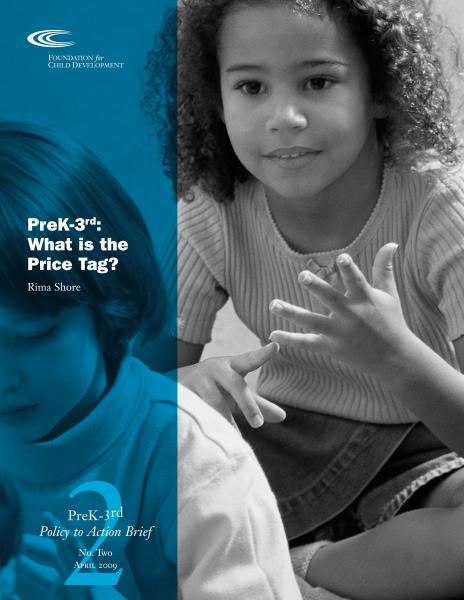
More important than the overall cost estimates Picus, Odden, and Goetz reach, however, is the framework they use to estimate those costs. As Rima Shore demonstrates in a new FCD issue brief, this framework provides a useful tool that states can use to determine how much it might cost them to establish a high-quality preK-3rd system, taking into account their own unique needs and goals. Because the framework identifies specific components of a preK-3rd system, state policymakers can adjust those components based on their own needs. For example, Picus, Odden, and Goetz’ model assumes class sizes of no more than 15 students in grades K-3, but a state could decide that it wanted to implement slightly larger class sizes and also provide more intensive support for English language learners. This framework can help states to consider such tradeoffs in designing early education investments.
As states begin receiving new federal stimulus funds under the American Recovery and Reinvestment Act (ARRA), this framework can help in another way, as well. By laying out different programmatic and staffing elements that contribute to high-quality preK-3rd systems, it also offers a menu of items that school districts can use their ARRA to invest in, in order to advance high-quality preK-3rd in their districts. Some elements of the framework, such as pre-k slots, full-day kindergarten, and new staff positions at the K-3 level, require ongoing funding commitments. But others, such as investments in professional development, aligning curriculum and instruction preK-3rd, or updating facilities to better meet the needs of young students, are one-time investments that deliver ongoing payoffs, making them good candidates for ARRA funds.
The Department of Education has already issued guidance that encourages districts to think about using ARRA funds to better align standards, curriculum, and instruction in grades preK-3rd, and, when there are plans in place for sustainability, to expand access to early education. Smart school districts such as
In the coming weeks we’ll have more to say about how school districts can and should use stimulus funds to advance a high-quality preK-3rd education.
More About the Author
Issues
Programs/Projects/Initiatives
Related

Five Things Principals Can Do to Protect Kindergarten’s Three Indispensables
Federal Early Education Update: September 2026

Five Things States Can Do to Support High-Quality Kindergarten and the Early Grades