State Fiscal Stabilization Application Update

The Department of Education recently approved the State Fiscal Stabilization Fund applications of three more states – Indiana, Rhode Island, and Tennessee. These states join the 13 that have already begun to receive funds. As of May 15th, nearly $565 million in SFSF monies have been disbursed to states. (A previous post analyzing the applications of the first 13 states can be found here.)
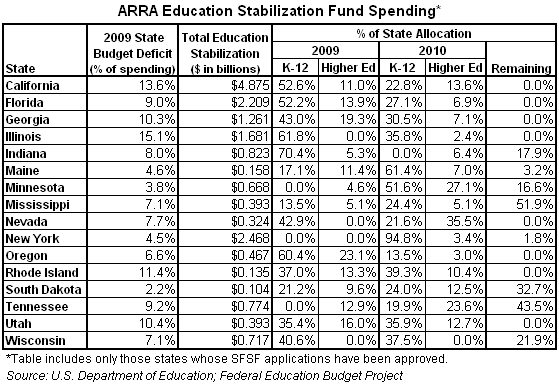
Indiana, Rhode Island, and Tennessee comprise an additional $1.7 billion in Education Stabilization funds and $386 million in Government Services funds. Of the three states, Rhode Island is expected to face the largest budget deficit as a percent of state spending – 11.4 percent – while Indiana is expected to face the smallest – 8.0 percent.
Nevertheless, Indiana’s SFSF application suggests that it will spend the highest percent of its Education Stabilization funds in 2009 on K-12 education of the three states, more than 70 percent. The state plans to spend just over 5 and 6 percent on higher education in 2009 and 2010, respectively. It does appear, however, that Indiana does not anticipate significant K-12 budget deficits in 2010. As a result, it will not spend any stabilization money on K-12 in 2010. Due to this distribution of spending, Indiana will have almost 18 percent of its Education Stabilization funds remaining after 2010.
Although Rhode Island will face the highest budget deficit as a percent of spending in 2009, it plans to distribute its use of Education Stabilization funds the most evenly across years and sectors of education. K-12 will receive roughly 38 percent of the funds in 2009 and 2010 while higher education will receive between 10 and 13 percent of the funds in each year. This distribution shows that Rhode Island does not intend to frontload its stabilization spending as other states appear to.
Tennessee is the only state of the 16 with approved applications that intends to spend a higher percentage of its Education Stabilization funds on higher ed than K-12 in both 2009 and 2010. In fact, Tennessee will not spend any of the funds on K-12 in 2009 and only 19.9 percent in 2010. Nevada and Minnesota are the only states that will spend a higher percent on higher ed than K-12 in a single year.
Government Services funds can be used for education purposes as well as other government services like public safety and health care. The specific uses of these funds are determined by each state’s governor. Indiana has not yet devised plans for any of its Government Services funds while Rhode Island plans to spend 100 percent of its funds on Public Safety. In contrast, Tennessee plans to spend the majority of its funds on K-12 and smaller amounts on Medicaid, children’s services, and health.
Ed Money Watch will continue to provide updates on the SFSF applications. Please check back for this coverage.
More About the Author
Issues
Related

Current Head Start Program Performance Standards Protect Children with Disabilities

New Report Offers Bipartisan Solutions to State Child Care Woes

Tracking the AI Economy: Seven Charts Every Presidential Candidate Should Study