State Fiscal Stabilization Application Update #2

The Department of Education recently approved the State Fiscal Stabilization Fund (SFSF) applications of five more states – Idaho, Massachusetts, North Carolina, Virginia, and Washington. These states join the 16 that have already begun to receive funds. As of May 22nd, nearly $773 million in SFSF monies have been disbursed to states. (Previous posts analyzing the applications of the first 16 states can be found here and here.)
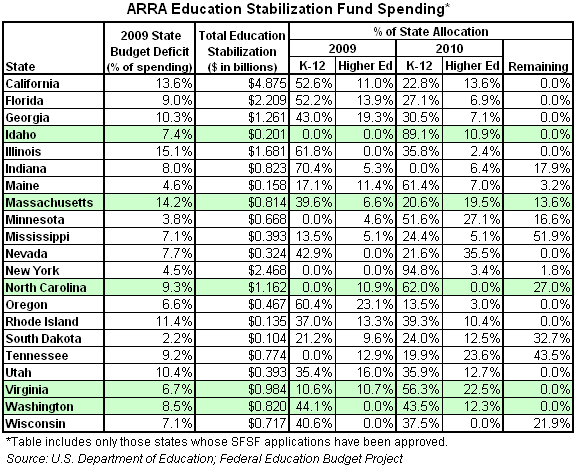
These five additional states make up another $4.0 billion in Education Stabilization funds and $886 million in Government Services funds. According to the Center for Budget and Policy Priorities, Massachusetts is expected to face the largest budget deficit as a percent of total state spending in fiscal year 2009 – 14.2 percent – while Virginia will experience the smallest – 6.7 percent.
Although Virginia will have the smallest deficit, its application suggests that it will use all of its available Education Stabilization funds in 2009 and 2010. In contrast, Massachusetts, with the highest projected deficit, and North Carolina, with the second highest deficit, will be the only states of the five to have money remaining after 2010, 13.6 percent and 26.0 percent of their total allocations, respectively.
Virginia, Idaho, and North Carolina have chosen to concentrate the majority of their spending in 2010, instead of 2009. For Virginia and Idaho, this is likely because both states have relatively low expected deficits – both below 8 percent. North Carolina, on the other hand, will have a deficit above 9 percent in 2009. Idaho will not be spending any Education Stabilization Funds in 2009, while North Carolina and Virginia will be spending just under 11 percent and 22 percent of their funds in the first year, respectively. However, all three states will be spending the majority of their 2010 funds on K-12, rather than higher education.
North Carolina’s distribution of funding is the most unusual of the five new states with approved applications. While the state will spend 10.9 percent of its funds on higher education and nothing on K-12 in 2009, it will spend 62.0 percent of its funds on K-12 in 2010 and nothing on higher education in 2010. This suggests a moderate deficit in higher education in 2009 and a much larger one in K-12 in 2010, an unusual pattern and one not seen in any other state so far. It raises questions about how the North Carolina government is budgeting for the two school systems in each year.
The fact that North Carolina also has a significant amount of Education Stabilization funds remaining after 2010 (27.0 percent) despite its relatively high projected deficit suggests that the formula used to distribute these funds did not effectively provide money to states that need it most to fill their budget gaps. The formula allocated SFSF dollars to states based on both the population age 5 to 24 (61 percent) and the total population (39 percent) in each state. As a result, states with particularly large school or college age populations received a disproportionate amount of money, regardless of their projected deficits.
Government Services funds under the SFSF can be used for education purposes as well as other services like public safety and health care. Each state’s governor determines how funds will be used. Four of the five states with recently approved applications will use at least some of their Government Services funds for public safety (all but Idaho). In general, public safety is a very common declared use for the funds. Both Idaho and Massachusetts will use a chunk of their Government Services funds for K-12 purposes, while Virginia will use some of its funds for higher education modernization. Massachusetts, Idaho, and Virginia also have not determined the uses for significant portions of their funds.
So far, 21 states have submitted their SFSF applications. It seems that some states, particularly those facing the smallest budget shortfalls, are taking their time getting their applications in to the U.S. Department of Education. A recent article from Ed Week suggests that this may be due to a lack of urgency on the part of the Governors, the fact that some states are just now finalizing their budgets, and the possibility that Governors are being thoughtful about the promises they must make when applying for SFSF monies.
Ed Money Watch will continue to provide updates on the SFSF applications. Please check back for this coverage.
More About the Author
Issues
Related

Current Head Start Program Performance Standards Protect Children with Disabilities

New Report Offers Bipartisan Solutions to State Child Care Woes

Tracking the AI Economy: Seven Charts Every Presidential Candidate Should Study