Lisa Guernsey
Senior Director, Birth to 12th Grade Policy; Co-Founder and Director, Learning Sciences Exchange

 One day my youngest daughter, Gillian, came home from preschool telling a glorious tale. Her class of 4-year-olds had baked a giant gingerbread man, but he escaped from the school’s oven. He left crumbs in the hallway and couldn’t be found in the stairwell. “Everybody gathered up together and put raisins on the floor and made a trap,” she told me. It worked: “We ate him all up.”
I ate it up too — the story, I mean. To me, this was preschool at its best. The fact that Gillian was utterly caught up in the drama – “It really happened Mom, I promise” – was icing on the cake, er, cookie.
Today, Gillian is experiencing her last day of preschool, so I can’t help but spend a little time reflecting on what made her preschool experience so rich and worthwhile. Yes the art projects were fabulous, the playground time was abundant (Gillian’s dreams almost always feature the tire swing), and circle time was just what she needed to learn to sit still for a few minutes and take turns listening to those around her.
But a big part of the impact came from having teachers who knew how to thread imaginative play into multiple activities — or let children do it themselves. Play has become a watchword in early childhood these days as educators strive to provide young children with the academic footings they need to succeed while not forgetting that kids at these ages are not, to use a common analogy, empty vessels to be filled with knowledge. Readers of Early Ed Watch know that we’ve weighed in on this challenge too, in posts about the Alliance for Childhood’s new report on kindergarten and a recent essay by Peggy Orenstein in the New York Times Magazine, not to mention in rooting for recess.
The shame is that somehow as word gets out for the push for more play, parents and educators start to set up a false dichotomy: Play versus academics. We’ve got to erase the “versus.” We can, should and must do both.
There is no longer any real debate over whether to teach academic skills in the early years, said Kathy Hirsh-Pasek, developmental psychologist at Temple University. Instead, she said, “The question is, How do you deliver the goods?”
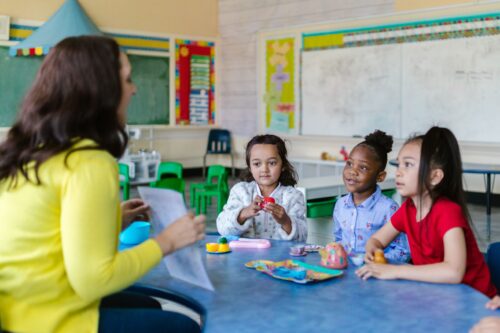
“Playful learning” is the approach urged by Hirsh-Pasek and many other developmental psychologists. This means more than passing a litmus test of whether playtime is built into the school day. The kind of play makes a difference. Instead of letting children aimlessly wander around pulling a few toys of the shelf, good teachers will give children ideas for extending their play and introduce them to new concepts and vocabulary along the way. This doesn’t mean hovering over children, putting words in their mouth. But it does mean giving them a model for new directions and possibilities. (“If Jasmine is going to be the doctor, do you want to be the nurse who takes the patient’s temperature? Or the lab technician who uses the microscope?”)
Or consider a play scenario in which children pretend to go to a grocery store or prepare a picnic. This can be an opportunity for conversations that incorporate early math skills. As Deborah Stipek, dean of Stanford University’s education school and an expert in early education, points out: “If they are putting weights on a balance they are doing algebra: two apples equal one grapefruit.”
Combining play with more intentional learning may not always seem easy. It takes thought , the support of administrators who recognize its value, and in many cases some inspiring training and professional development.
Fortunately, starting on June 14, many educators around the country will have an opportunity to gain exactly that at the annual professional development institute hosted by the National Association for the Education of Young Children. This year it takes place in Charlotte, N.C. The theme is “Play: Where Learning Begins.” If you will be there, please let us know. We’d love to hear stories of what sessions were most helpful.
Meanwhile, here are a few more resources to take advantage of:
And if you, too, want to run after the gingerbread man, some teachers in Houston will show you how to set up a week of gingerbread-man mania in your school.
Senior Director, Birth to 12th Grade Policy; Co-Founder and Director, Learning Sciences Exchange