Jason Delisle
Director, Federal Education Budget Project

The U.S. House of Representatives has taken another step in the annual process to determine fiscal year 2010 funding levels for most federal education programs. Fiscal year 2010 begins this October 1st. This week, the House Appropriations Committee released the 302(b) suballocations to each of its subcommittees so that they may begin drafting fiscal year 2010 appropriations bills. While this development means little for federal education programs, it is the second step in a long process of narrowing funding decisions down to specific education programs.
Back in April, Congress adopted a budget resolution that set total fiscal year 2010 appropriations funding across all federal programs at $1.082 trillion, up $70 billion from the current fiscal year. The limit is called a 302(a) allocation after the relevant section of federal budget law. But this spending limit does not include any spending limits or recommendations for individual agencies or programs. It is only an aggregate limit on all federal discretionary spending. Individual funding levels for specific programs, including education programs, are determined by the 12 subcommittees of the Appropriations Committees in draft legislation that is voted on in the House and Senate.
To help ensure that the 12 separate appropriations bills, each drafted by a subcommittee, do not exceed the $1.082 trillion allocation, each subcommittee is given its own suballocation for when it drafts its bill. The Labor, Health and Human Services, Education, and Related Agencies Appropriations Subcommittees (Labor-HHS-Education) have jurisdiction over spending for the Department of Education. The House has set this subcommittee’s fiscal year 2010 302(b) allocation at $160.7 billion, up $8.0 billion from $152.6 billion in fiscal year 2009.
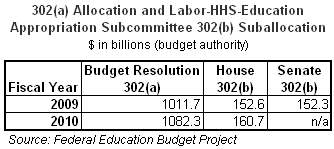
While the $8.0 billion increase from the prior year’s suballocation is significant, it is still too early to tell how it might affect education funding in fiscal year 2010 because that increase is not necessarily for education programs. The increase might all be put toward health care or Department of Labor programs, which are under the jurisdiction of the Labor-HHS-Education Appropriations Subcommittee as well. We will know the answer to this question once the Labor-HHS-Education Appropriations Subcommittee releases a draft of its proposed appropriations bill, the next step in the 2010 appropriation process. Additionally, the Senate Labor-HHS-Education Appropriations Subcommittee has yet to release its fiscal year 2010 302(b) suballocations, which will also play an important role in the appropriations process.
Although Congress is not required to honor his requests, the president’s 2010 budget request indicates that there may be several changes in the Department of Education budget from fiscal year 2009 levels. Potential changes include increases in funding for School Improvement efforts and the Teacher Incentive Fund. At the same time, President Obama also requested cuts in Title I Part A funding and significant shifts in funding for higher education financial aid. These changes are likely to incite some political struggles as the budget process moves forward.
Once any of this information is released, we will have an update for you here at Ed Money Watch.
Director, Federal Education Budget Project