State Fiscal Stabilization Fund Application Update #6

Over the past couple of weeks, the Department of Education has approved the State Fiscal Stabilization Fund (SFSF) applications of 14 more states. These states join the 36 states/territories that have already begun to receive funds. As of July 17th, nearly $8.7 billion in SFSF monies have been disbursed to states. (Previous posts analyzing the applications of the first 36 states/territories can be found here, here, here, here, here, and here.)
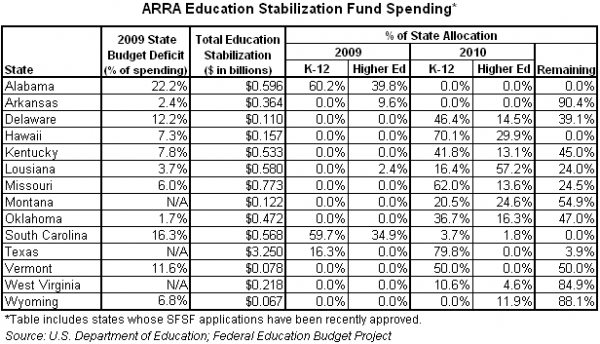
The full table of all approved states/territories can be accessed here.
These five additional states make up another $7.9 billion in Education Stabilization funds and $1.8 billion in Government Services funds under the American Recovery and Reinvestment Act of 2009. These recently approved states/territories are expected to face widely varying budget deficits as a percent of total state spending according to the Center for Budget and Policy Priorities. Alabama is expected to face the highest deficit as 22.2 percent, while Oklahoma is expected to face the lowest at 1.7 percent. Deficit estimates were not available for Montana, Texas, and West Virginia.
The vast majority of these states do not expect to spend any Education Stabilization funds in fiscal year 2009, likely due to relatively low projected deficits. Alabama and South Carolina, however, plan to spend 60 percent or more of their total funds on K-12 and 35 percent or more in higher education in 2009. These two states are expected to have the highest budget deficits of all 14 recently approved states, explaining their desire to spend the funds immediately. Texas and Louisiana will also spend some funds in 2009 but reserve the majority of their spending for 2010.
Like most states, almost all of the recently approved states will spend the majority of their Education Stabilization funds on K-12, rather than higher education. Louisiana, however, is an exception and plans to spend 57.2 percent of its funds on higher education in 2010 alone. South Carolina and Hawaii are also spending a higher than average proportion of their funds on higher education – 36.7 percent and 29.9 percent total, respectively.
Due to limited spending in 2009, all but three of these recently approved states will have Education Stabilization funds remaining in 2011. According to ARRA, all funds not spent before 2011 must be distributed to local education agencies (LEAs) via Title I formulas. Arkansas will have the most with more than 90 percent of total funds remaining, while Louisiana will have the least with 24 percent remaining.
Government Services funds under the SFSF can be used for education purposes as well as other services like public safety and health care. Each state’s governor determines how funds will be used. The majority of these recently approved states have elected to use at least some portion of their Government Services funds on Public Safety. Several others will use some of these funds for additional K-12 and higher education spending as well as for repair and modernization of educational facilities. Vermont, West Virginia, Montana, and Oklahoma will all also spend some funds on public assistance or other economic development efforts.
At this point, only Pennsylvania and the Northern Mariana Islands have outstanding State Fiscal Stabilization applications. Pennsylvania’s application is likely held up due to disagreements over spending on state-related universities (discussed here). Meanwhile, the rest of the states are waiting to complete their Phase 2 applications, which will require more specific information on tracking and spending SFSF monies. Thos applications are expected to be released soon.
Ed Money Watch will continue to provide updates on the SFSF applications. Please check back for this coverage.
More About the Author
Issues
Related

Current Head Start Program Performance Standards Protect Children with Disabilities

New Report Offers Bipartisan Solutions to State Child Care Woes

Tracking the AI Economy: Seven Charts Every Presidential Candidate Should Study