
Book Notes: What Montgomery County Does Right

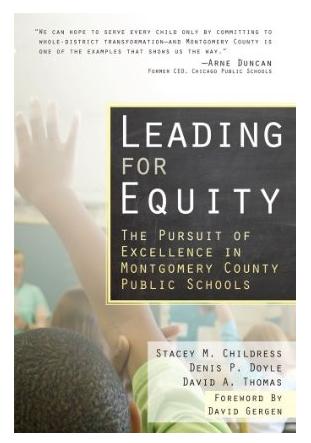 As regular readers of this blog know, Montgomery County Public Schools has done a good job capturing our attention with its PreK-3rd alignment effort and high-quality early childhood programs. Now a new book, Leading for Equity, argues that Superintendent Jerry Weast’s approach to management, which emphasized equity and excellence for all, was the key to success in MCPS.
This substantive but somewhat colorless book was written by three people who specialize in education leadership: Stacey M. Childress and David A. Thomas, who currently teach at Harvard Business School, and Denis P. Doyle, the chief academic officer of SchoolNet, which produces instructional management software.
Jay Mathews at the Washington Post recently skewered the authors for relying too much on education jargon in their analysis of MCPS’ success, which they summarized as six lessons. Early Ed Watch helpfully translates for the common man: 1) adopt common, rigorous standards, and differentiate instruction rather than lowering expectations by placing struggling students in lower tracks, 2) focus on critical stages of the K-12 path, especially early childhood and the last years of high school, 3) hold everyone accountable and include everyone in the decision-making process, 4) persuade people of all students’ ability to excel by requiring the use of programs that increase student achievement, 5) hire and retain people who believe that minority and low-income students can achieve at a high level and 6) always pursue equity and hold it as a top priority.
Many of these lessons are applicable to education reform in the early years. The third lesson is particularly significant, in that shared accountability and cooperation was critical to the success of all the reforms. For example, by strengthening collaboration between preschool programs, Head Start, and the early elementary grades, Superintendent Weast was able to implement changes such as higher standards in early childhood and new programs focused on increasing young students’ achievement.
Weast did not stop at improving standards–he made sure early learning guidelines were aligned. Now, regardless of whether a child is in federal pre-K (Head Start) or locally-funded pre-K, he or she will experience the same expectations, quality, and teaching strategies, and the curriculum used in both types of pre-k programs is designed to build seamlessly into what children will learn in kindergarten.
Weast’s leadership also emphasized college readiness: as superintendent he expanded students’ access to AP classes and increasing participation on college entrance exams. But Weast also recognized that to access those classes and perform well on those exams, students first needed strong reading and math skills-and the development of those crucial skills must begin not in high school, when it was often too late, but in early childhood. So even as Weast expanded access to advanced classes in the upper grades, he also focused on increasing the frequency of high-quality instruction in the lower grades-a “push-pull” approach in which gains from PreK-3rd
would push from below and rigor in the upper grades would pull from above.
The “push” in PreK-3rd was dubbed the Early Success Performance Plan, and included many elements indicative of high-quality PreK-3rd early learning program, such as small class sizes, a focus on literacy, and permanent professional development coaches to support teachers.
MCPS’ success is visible in students’ early years. By 2008, 93 percent of kindergarteners could read a simple story, and the achievement gap in third grade had shrunk by approximately 30 percentage points, according to MCPS and the state-assessment results. Nevertheless, Weast’s focus on increasing student participation on national tests such as the SAT and ACT is associated with a drop in average scores.
It’s easy to see Weast as the hero of this story, but Leading for Equity shows that his methods, not his personality, led to success in Montgomery County. The authors’ careful enumeration of what worked and why suggests that MCPS’ success can be replicated by implementing a similar strategy. (We’ve written recently about successes in Bremerton, Wash., for example.) Weast has been getting a lot of attention lately, so we’re eager for reports of other educational leaders or teams of reformers who have made a difference in other places. Know of any we’ve missed?
Issues
Programs/Projects/Initiatives
Related

Five Things States Can Do to Support High-Quality Kindergarten and the Early Grades

Current Head Start Program Performance Standards Protect Children with Disabilities