New Report: On the Cusp in California

As a recent TIME cover story notes, California is a state teeming with problems: Facing a 35 percent budget gap earlier this year, the state teetered on the verge of bankruptcy. It has a notoriously dysfunctional legislature and the nation’s fourth-highest unemployment rate.
On top of that, California’s schools, once among the nation’s best, now rank among the bottom of all states– 46th nationally in 4th grade math, and 47th in reading. Equally troubling large achievement gaps between white and black or Hispanic fourth-graders. These problems begin even before children enter kindergarten. Only 31 percent of the state’s 4-year-olds are enrolled in state-funded preschool or Head Start-and many early care and education settings fall short of high quality standards. These figures are particularly troubling considering that the state is host to one in every eight children under the age of eight in the country.
But, as a new report from the New America Foundation’s Early Education Initiative argues, there are reasons for hope. Despite budget shortfalls, California is on the cusp of making real improvements in its early education system.
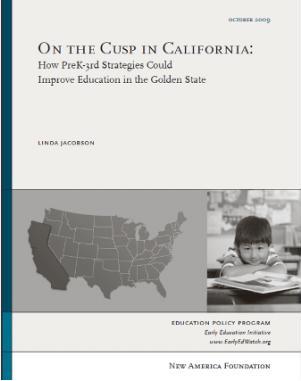
On the Cusp in California: How PreK-3rd Strategies Could Improve Education in the Golden State, written by long-time California education reporter Linda Jacobson, explains that key state officials, along with early childhood advocates and school reformers, have taken some important first steps to better integrate early childhood programs and move towards the more seamless PreK-3rd early education system in California. Now policymakers and advocates need to exert leadership to create a sense of urgency around PreK-3rd reform as a strategy for improving California’s education system.
PreK-3rd reforms– which combine high-quality pre-k and full-day kindergarten with a high-quality, aligned early elementary learning experiences that seamlessly build children’s skills and knowledge to bring them to proficiency by the end of third grade-have tremendous potential to help California narrow achievement gaps and raise student learning across the board. The report seeks to help policymakers and advocates in California understand the promise of PreK-3rd PreK-3rd strategies as well as the hurdles, and the steps the state can take to overcome them.
The report recommends 13 steps to getting this done – many of which are not budget-busters and may even help California compete for federal education grants, such as the Race to the Top program and the proposed Early Learning Challenge fund. For example, the report recommends that the state:
- Replicate and scale up effective PreK-3rd models,
- Implement a comprehensive early childhood data system,
- Integrate pre-k funding into broader conversations about reforming the state’s school finance system,
- Continue working to develop and fund a voluntary Quality Rating and Improvement System (QRIS), and
- Create a PreK-3rd teacher credential for early childhood educators.
The report also includes recommendations to improve coordination and quality among existing early care and education programs in the state and to address the needs of California’s growing population of English language learner and Hispanic students. For the full list of recommendations, check out the report here. Today in Sacramento, New America is presenting details from the report to a gathering of policymakers and stakeholders.
The report was funded through generous grants from the Foundation for Child Development, the W. Clement adn Jessie V. Stone Foundation, and the Strategic Knowledge Fund, co-funded by the Foundation for Child Development and the W.K. Kellogg Foundation.
Issues
Programs/Projects/Initiatives
Related
Federal Early Education Update: September 2026

Five Things States Can Do to Support High-Quality Kindergarten and the Early Grades