Comparing Department of Education and Recipient Reported Stimulus Data

When Congress passed the American Recovery and Reinvestment Act (ARRA), they included extensive data reporting requirements so that the public could closely track expenditures. Now that the recipient reported data on expenditures is publically available, tracking education funds should be easy. But as we discussed earlier this week, data reported by school districts and institutions of higher education is lacking in comprehensive information and is difficult to decipher. Unfortunately, state-level recipient reported data does not match previously available Department of Education (ED) reported data for many states, further undermining the value of the data. If the point of the data collection process was to provide accessible data on the progress of the stimulus, this data falls short of that goal.
ARRA recipients reported the total amount of federal stimulus funds they had received as of September 30th, 2009 for all stimulus programs (except Pell Grants). This data can be compared to data ED reported on the amount of funds disbursed for the same programs. To do this comparison, we aggregated the recipient reported data on total ARRA funds received by state and compared it to ED’s reports on funds it disbursed after subtracting any disbursements related to Pell Grants. We found a fair number of discrepancies between the recipient and agency reported data.
Of the 50 states, Puerto Rico, and the District of Columbia, only 27 states or territories reported grant amounts received that were anywhere near the amount that ED reported it had disbursed. The majority of these states reported slightly higher amounts of funds received than the ED agency reported data.
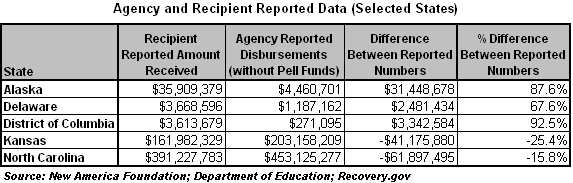
Of the 25 states or territories that reported data that differed from data that ED reported by more than 5 percent, 20 reported receiving higher amounts. For example, the District of Columbia reported that it had received $3.6 million in federal stimulus grants as of September 30th. However, the ED reported data suggests that only $271,095 had been disbursed to DC as of that date, a discrepancy of 92.5 percent. Similarly, there is a discrepancy of 87.6 percent and 67.6 percent between Alaska’s and Delaware’s recipient and ED reported data, respectively.
Five states reported lower amounts of federal stimulus funds received than the ED reported data suggests. For example, Kansas reported that it received $42.2 million less than the ED agency reported $203.2 million, a 25.4 percent difference. North Carolina also reported that it had received $391.2 million, $61.9 million less than ED reported it had disbursed.
Without further information on how the states reported the amount they had received, it is impossible to understand why the recipient reported data differs from the agency reported data so greatly. However, these discrepancies call into question the value and validity of the recipient reported data in general. It seems that the states were either ill equipped to collect this data in such a short time span or the school districts and institutions or higher education are doing a poor job of tracking the funds as they come in. Either way, these data suggest that the current recipient reported data system will require significant refinement to become completely useful.
Complete data for all 50 states, Puerto Rico and DC is available here.
More About the Author
Issues
Related

Current Head Start Program Performance Standards Protect Children with Disabilities

New Report Offers Bipartisan Solutions to State Child Care Woes

Tracking the AI Economy: Seven Charts Every Presidential Candidate Should Study