Lisa Guernsey
Senior Director, Birth to 12th Grade Policy; Co-Founder and Director, Learning Sciences Exchange

Elizabeth Green’s article in the New York Times Magazine this week has already attracted attention from educators and parents around the country. The piece, “Building a Better Teacher,” attempts to answer a question looming large these days: Can good teachers be trained? The answer is partly framed as a debate between philosophies emphasizing the need for teachers to become smarter about the content they are teaching and philosophies on the importance of classroom management. What seems apparent from the article — though no doubt it will surely continue to be a subject of fascinating discussion over the coming years — is that you need both.
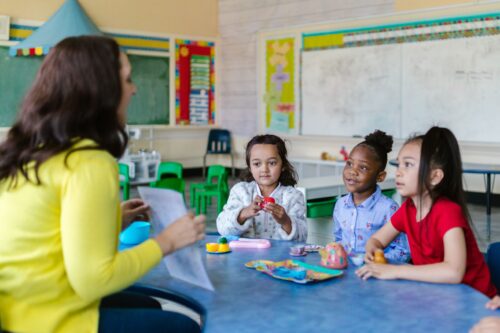
But deep inside the article, almost as a sideline to the content-vs-management question, Green sets a scene that is worth replaying. It grabbed our attention because it focused on math instruction for elementary school students, but it has implications for even younger kids as well. Several paragraphs describe the work of Deborah Loewenberg Ball, dean of the University of Michigan’s school of education, and how she came to understand what teachers need to do to succeed.
Ball filmed herself in 1990 when she was teaching a third-grade math class. The film becomes a prototype for the kind of give-and-take and authentic questioning that comes from teachers who have a deep understanding of both the content they are teaching and the way their students are processing that content. To quote:
On one tape from that year, Ball started her day by calling on a boy known to the researchers as Sean.“I was just thinking about six,” Sean began. “I’m just thinking, it can be an odd number, too.” Ball did not shake her head no. Sean went on, speaking faster. “Cause there could be two, four, six, and two — three twos, that’d make six!”“Uh-huh,” Ball said.“And two threes,” Sean said, gaining steam. “It could be an odd and an even number. Both!”He looked up at Ball, who was sitting in a chair among the students, wearing a black-and-red jumper and oversize eyeglasses. She continued not to contradict him, and he went on not making sense. Then Ball looked to the class. “Other people’s comments?” she asked calmly.
The teaching moment continues until eventually the class, collectively, comes to new conclusions about odd and even numbers that show a deeper grasp of math than many adults can even lay claim to. This was possible because of both Ball’s in-depth knowledge of math and an ability to think about how children think. As Green describes it:
[Ball’s] goal in filming her class was to capture and then study, categorize and describe the work of teaching — the knowledge and skills involved in getting a class of 8-year-olds to understand a year’s worth of math. Her somewhat surprising conclusion: Teaching, even teaching third-grade math, is extraordinarily specialized, requiring both intricate skills and complex knowledge about math.
That insight — that teaching is extraordinarily specialized — deserves some rumination. Teachers have to know their subject matter, know how to manage their classrooms so that children pay attention to that subject matter, and know what those children might be misunderstanding about that subject matter. Tricky stuff indeed.
P.S. Don’t miss the videos, some of which show classrooms of elementary-school age children. Each video is an example of a particular classroom management technique as defined by Doug Lemov, the founder of the charter schools called Uncommon Schools and a pedagogical expert at the center of the article.
Senior Director, Birth to 12th Grade Policy; Co-Founder and Director, Learning Sciences Exchange