Dual Language Learners: A Two-Way Immersion Approach

This is the third post in our four-part series on dual language learners. So far, we’ve highlighted some key pieces of research on how to teach young dual language learners and explored what Head Start is doing to help support the home languages of its participants. Today, we will focus on CentroNia, an organization headquartered in Washington, D.C., that runs early childhood programs for children from infancy to age 5 plus a charter school for the K-5 grades – all using a two-way immersion model for bilingual education. In our final post, we will wrap up the series with some resources and recommendations for educators and policymakers.
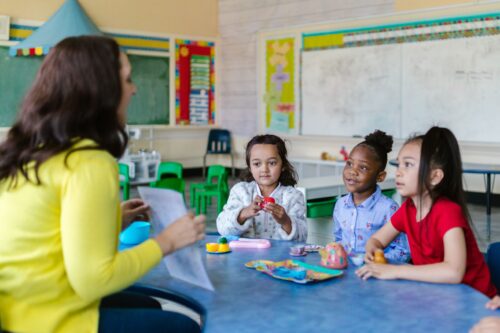
<div>Earlier this month, I visited <a href="http://www.centronia.org/">CentroNia </a>sites in Washington DC and the nearby city of Silver Spring, Md. As in many schools, the walls are decorated with posters, student art, and instructions on hand-washing or how to wipe off the tables for lunch. But there is one key difference: in CentroNia classrooms, the printed words appear twice—once in English and once in Spanish.</div><div> </div> <div>CentroNia runs infant and toddler programs, preschools, and its elementary charter school as two-way immersion programs for children who speak Spanish, English or a combination of the two. While in two-way immersion, students at CentroNia learn together regardless of what language they speak at home. Teachers don’t “pull out” native English or Spanish speakers to focus on their second language skills, a strategy commonly used in elementary schools.</div><div> </div> <div>The goal, according to the CentroNia’s stated learning model, is to graduate fully bilingual students who have also received a high-quality education in subject areas like science and math. The program started 23 years ago and has expanded to serve over 1,500 children between 3 months old and 5<sup>th</sup> grade. Many students qualify for federal child care subsidies or Head Start. A small percentage of students arrive from families that pay full tuition.</div><div> </div> <div>So, what does CentroNia’s two-way immersion program look like? For 3- and 4-year-olds, each classroom in a CentroNia school is equipped with an English-speaking teacher and a Spanish-speaking teacher, but lessons are not taught simultaneously in both languages. One is the lead teacher, who must have a bachelor’s degree; the other is the assistant, who is required to have at least a Child Development Associate certificate, or CDA. Both co-plan and carry out instruction, regardless of which teacher is the “lead” teacher, or what language he or she is dominant in. Renata Claros, CentroNia’s early childhood director, described the pre-K classes as more “organic” in their delivery of language-based instruction than than what is provided at the elementary school, with native English and Spanish-speakers learning together using a Creative Curriculm framework that is approved by the District of Columbia.</div><div> </div> <div>The delivery of instruction changes in kindergarten. For the kindergarten through fourth grades, students move between two rooms -- a Spanish-language classroom and an English-language classroom. The switch occurs in the middle of the day, so each day is 50 percent English learning and 50 percent Spanish learning. Students learn language arts in both Spanish and English, and students develop literacy skills side-by-side, regardless of their home language. Other subjects are divided between English and Spanish instruction: Math is in English, science is in Spanish, and other classes (such as social studies) vary by year. Fifth graders follow a similar breakdown, but do not physically move from classroom to classroom halfway through the day.</div><div> </div> <div>As <i>Early Ed Watch</i> discussed in <a href="http://earlyed.newamerica.net/blogposts/2010/dual_language_learners_what_early_educators_need_to_know-28196">our first post in this series</a>, research is still in its infancy on what type of dual language education is most successful. The organization has built its approach to dual language instruction over time, and considers itself to be a work-in-progress. Based on successes and failures that teachers see in the classroom, coupled with data from regular assessments conducted by researchers at Howard University and the Center for Urban Progress, CentroNia tries to build the best possible program, said Christian Gonzales, CentroNia’s outcomes manager.</div><div> </div> <div>Yet even after 23 years of operation, CentroNia is still facing some tough challenges. One challenge is data collection: Though its elementary school assesses its students regularly, it has no way of tracking their progress through middle and high school, leaving a dearth of information about how well the two-way immersion system ultimately serves kids.</div><div> </div> <div>Another issue is that charter schools in D.C. operate on a lottery system. This means that students enrolled in CentroNia’s preschool classrooms are not guaranteed placement in the CentroNia elementary charter school. Some years, few students move through the whole PreK-5 CentroNia program. This is problematic when you consider that it takes years for full bilingual skills to develop.</div> <div>These challenges, however, are not swaying CentroNia’s leaders away from their core mission of delivering a bilingual and well-aligned educational experience. For example, Hispanic and Latino children who are taught in Spanish, and who learn grammar, history and science in Spanish, are gaining deep knowledge of—and respect for— the language of their families and community that they might not otherwise receive. As Claros said, “We want children to understand that the elders and adults in their lives have different languages.” When examined through this lens, there is another, crucial lesson to be found in two-way immersion: that Spanish is not a secondary language to English.</div><div> </div> <div>For those who are curious about ways that policymakers and educators could improve experiences for dual-language learners next week’s post will pose some ideas and recommendations for dual language education (and some useful online resources, too).</div>
More About the Author
Issues
Programs/Projects/Initiatives
Related
Five Things Principals Can Do to Protect Kindergarten’s Three Indispensables

Federal Early Education Update: September 2026

Five Things States Can Do to Support High-Quality Kindergarten and the Early Grades