Yesterday was a banner day for the standards movement in education: Two groups representing nearly every state in the U.S. released
the final version of a document that outlines what every American student should be able to know and do at the end of each grade, K-12.
The Common Standards, as they are called, should trigger many conversations over the coming days and weeks – and their very existence may lead to a new era in educational policy — but we’ll just zoom in on one of them this morning: How well should children be reading by the end of kindergarten?
This is a perennial question in debates over early literacy instruction, and it became especially relevant this spring when a
draft of the Common Standards was released. In that version, one of the reading standards, under the “fluency” heading for foundational skills, looked like this:
Read with sufficient accuracy and fluency to support comprehension.
a. Read emergent-reader texts with purpose and understanding.
The final version, however, eliminates the top line. Under fluency it now simply says:
Read emergent-reader texts with purpose and understanding.
Also new are the way the final standards talk about range of reading and level of text complexity expected of kindergartners. Instead of that same “reading emergent-reader texts with purpose and understanding,” the standard now says:
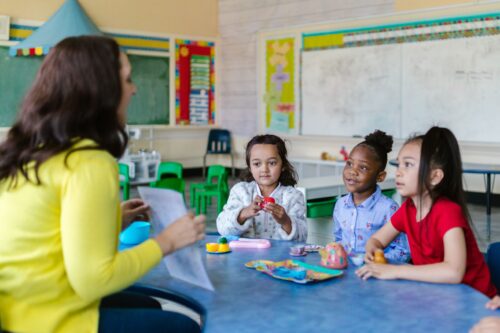
Actively engage in group reading activities with purpose and understanding.
These changes are important. They signify that the two groups that created the standards – the Council of Chief State School Officers and the National Governor’s Association – were listening closely when many early childhood specialists raised concerns in March about the first draft of the standards for kindergarten through third grade. Several experts
worried that the standard didn’t reflect the range of development in reading skills that children may exhibit at ages 4, 5 and 6. In some districts, for example, children enter kindergarten at age 4 — is it appropriate to ask children of this age to be reading fluently just nine months later? What about children who might still show no outward signs of reading in their last month of kindergarten but suddenly appear to “get it” a month later, as can happen among young kids? More importantly, what exactly does fluency mean at these young ages?
It isn’t easy to find a balance between underestimating young children’s intellectual abilities (which we believe happens entirely too often) and setting unreasonable expectations about academic skills that they should master in their early years. Content and reading experts will have much more to say about what is appropriate and rigorous enough for young children – please comment below if you have thoughts on this – but this standard appears to recognize that even if children to exhibit varying levels of reading ability at the end of kindergarten they can still be on track to exhibiting strong reading skills a year later. Research shows that reading proficiently by third grade is critical to ensuring that children find success in school.
The Standards define what all students are expected to know and be able to do, not how teachers should teach. For instance, the use of play with young children is not specified by the Standards, but it is welcome as a valuable activity in its own right and as a way to help students meet the expectations in this document.
It is still unclear how many states will adopt the Common Standards. Forty-eight states, two territories and the District of Columbia signed on to the Common Core Standards Initiative when it was announced last summer. Texas and Alaska opted out. Last week, Virginia announced that it would not use them either, saying that its own Standards of Learning are superior and that it had invested too much in them to turn to a different system now. But other states, like Maryland, have announced that they will use them.
The Common Standards are not mandated by the federal government – this was pointedly a state-led effort — but the Obama administration has made clear that it sees common standards as critical to its reform effort. The U.S. Department of Education has already tied federal money to states’ embrace of common standards. States vying for grants from the
Race to the Top program, for example, received 40 points (out of a possible 500) for participating in the consortium and taking steps to adopt the standards.
We’ll be watching closely to see how states and school districts react to and change practices based upon these common standards. But we should remember that these standards are only the beginning. What matters now is how they are interpreted: Will teachers adapt to give students the instruction they need to meet these standards by the end of the year? Will curricula be rich and flexible enough to capture what is expected in these standards? Will new assessments be able to accurately reflect whether students have successfully learned the content required by the standards? Will districts provide the type of professional development teachers need to align what they are doing in the classroom with the standards?
And how will the pre-K years fit in? The Common Standards are only for the K-12 grades, although CCSSO and NGA have said they will soon be starting on a set of standards for birth to 5 years old that would align with the K-12 ones. Here at
Early Ed Watch, we
have been concerned that this break point – between pre-K and K-12 – simply reinforces an already artificial and problematic divide when it comes to children’s learning experiences in the early years. We think the creation of standards for the early years are important (many states already have published guidance on the developmental milestones that very young children should be reaching each year), but we will need to make strong connections between the two sets of standards wherever possible.
Many more sections of the standards – which are available for
language arts and
math — deserve a close look. They will be officially reviewed, according to the Initiative, on a set cycle. If you have thoughts on the standards, let us know, and we’ll try to keep you up to date on issues and analyses as they appear.