Lisa Guernsey
Senior Director, Birth to 12th Grade Policy; Co-Founder and Director, Learning Sciences Exchange

The early learning initiatives developed by Montgomery County Public Schools have attracted a good share of national attention recently. (Early Ed Watch may have played a small role in that, with the production a video in 2009 and MCPS’s inclusion on a panel discussion in March.) Now the school district has created another media splash with the announcement that Superintendent Jerry Weast will retire next year and the release of a report on the fruits of his efforts.
With attention, however, comes scrutiny. A few bloggers have raised questions worth dwelling on, and we have some of our own. As Weast says in the report, funded by Pre-K Now and the Foundation for Child Development*, “the work is never finished.”
The report is titled, “Lessons in Early Learning: Building an Integrated Pre-K-12 System in Montgomery County Public Schools.” It compellingly describes how the district integrated early childhood programs into its broader education goals – including the expansion of pre-k, more support for kindergarten and an emphasis on improvement in the early grades. Today, almost 90 percent of kindergartners enter first grade with “essential literacy skills,” the report says, and achievement gaps across all grade levels, while still apparent, are shrinking.
But the findings and Weast’s forthcoming departure begs the question: What’s next? Where are the weak spots?
One area that we’re concerned about, for example, is the achievement of Hispanic children, who in many cases are still behind. But before we get to that, let me address a few other questions that have come from those focused on the very youngest children, the pre-k and kindergartners.
At Ed Week’s Early Years blog, for example, Maureen Kelleher uses an anecdote from a friend with a kindergartner at MCPS to ask whether playtime and learning time are well balanced in the system’s kindergartens.
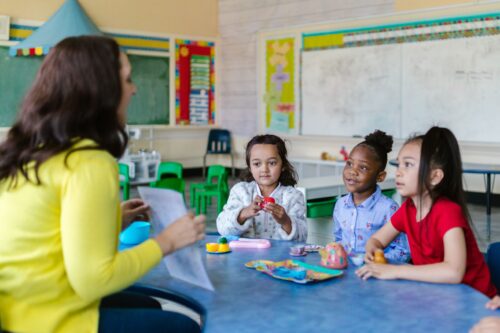
It’s a perennial question as preschools and schools shift to more intentional and focused teaching in classrooms for young children. As a mother with a just-graduated kindergartner, I have seen firsthand how abrupt that change can be between preschool and kindergarten. So let me spend a moment describing what I have seen inside several pre-kindergarten, kindergarten and first-grade classrooms in Montgomery County. I have seen bright and active classrooms with low child-to-teacher ratios that enable teachers to work in small groups of children, sitting on the rug and playing games and talking about books. I have also seen intentional teaching tailored to specific children’s needs, which research has shown to be tremendously beneficial.
But there will always be room for improvement. Early learning professionals nationwide – not just in MCPS — could benefit from learning more about how to integrate play as they introduce children to new concepts in math and science, as well as storytelling and oral-language. A program called Tools of the Mind has been offered as one promising answer. Another possibility is to look at how some schools are using storytelling and playful learning to enhance literacy instruction, such as the KIPP DREAM preK-3rd school in Houston, Tex.
Granted, my observations of MCPS are anecdotal and based on short classroom visits. We don’t have school-wide or district-wide information about these kinds of quality indicators, partly because they are very hard to measure. Actually, there are some good tools for measuring how teachers use their time in kindergarten and the quality of their interactions with students, but so far they have been used predominantly by education researchers and haven’t become widespread enough to make fair comparisons between schools and districts.
Without those kinds of indicators, we have to rely on standardized test scores to give us a sense of the effectiveness of MCPS’s program. In the Pre-K Now report, the data looks impressive. Here’s how reading scores have climbed in the past seven years:


But Liz Willen of Early Stories asks another smart question: How does MCPS’s program compare with surrounding areas?
Some quick answers come from the online database for the Maryland State Report Card, maintained by the state’s department of education, which provides county-by-county data that can be broken down by subgroups. Consider, for example, the 2009 testing data on children who are eligible for Title I programs for the disadvantaged. The database shows that 78.8 percent of MCPS Title I students hit the state’s third-grade reading benchmark. In the state, the percentage is lower — 75 percent. And in neighboring Prince George’s county, just 69.2 percent hit that mark.
Looking at it through the lens of race and ethnicity, MCPS African-American students are doing better on reading and math than their counterparts in the state as a whole. And MCPS white students are ahead of everyone around the state, which is not surprising given that Montgomery County has a large population of affluent and highly educated white parents.
But Hispanic students in the county aren’t faring as well. According to the 2009 data, a smaller percentage of Hispanic third-graders at MCPS are meeting proficiency standards than Hispanic third-graders statewide. Here’s a table with the percentage of students who scored “proficient” or above on the Maryland State Assessment:
|
% of Hispanics Proficient on MSA 2009, Third Grade |
||
|
|
Reading |
Math |
|
MCPS |
78.7* |
79.5 |
|
STATE |
79.3 |
82.1 |
There are several good folks at the helm in MCPS, like Janine Bacquie, the director of early childhood programs. We know that they too are looking closely at how to improve outcomes among Hispanic children and other subgroups that may need additional interventions. And this is not a question solely for MCPS. There is so much more work to do in determining the best ways to help Hispanic children and dual-language learners across the country.
Overall, the strength of the Pre-K Now report – as well as Leading for Equity, a case study of MCPS by Harvard Education Press – is the accumulation of lessons learned. The report includes descriptions of steps taken by both the district and the state of Maryland to coordinate and expand early learning programs to support the full pre-K-12 continuum. This should help to advance discussions of the importance of supporting pre-kindergarten and the early grades in the reauthorization of the Elementary and Secondary Education Act.
P.S. If you’re interested in exploring MCPS’s demographics and achievement data compared to other school districts around the country, don’t forget that here at New America we have tool for making comparisons of districts within and across states: The Federal Education Budget Project. But be aware that one state’s benchmark for proficiency on standardized tests could be very different than another’s – and that the tests between states are different as well.
* Full disclosure: The Foundation for Child Development is among the funders for Early Ed Watch and the Early Education Initiative.
Senior Director, Birth to 12th Grade Policy; Co-Founder and Director, Learning Sciences Exchange