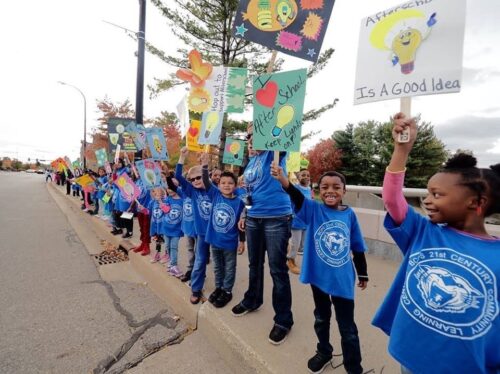
Afterschool Meal Program Could Reach All 50 States

Last month, the U.S. Census Bureau announced that the nation’s poverty rate had reached 14.3 percent, the third consecutive increase in the poverty rate. This means that 43.6 million people in America are living in poverty and many of them are children. The federal government provides several programs to help support children living in poverty, including Title I Education for the Disadvantaged grants, the School Lunch Program, and McKinney-Vento Homeless Education program. But one rarely discussed program is becoming more important than ever – the Child and Adult Care Food Program’s At-Risk Afterschool Meals program.
This relatively new program, started by the Agricultural Risk Protection Act of 2000, provides complete meals to students in afterschool programs where at least 50 percent of local school children are eligible for free and reduced price lunches. Unlike the school lunch program, for which some children pay a reduced or full price, afterschool meals are provided free of charge to all students. For many of these students, the meal they receive at their afterschool program is the last meal they eat for the day. The program is meant to combat child hunger and obesity by providing quality meals to students who otherwise would have limited access to food after school and to attract students to afterschool programs that offer additional academic support.
Currently, the federal government has selected only 13 states and the District of Columbia to participate in this program. These states include Connecticut, Delaware, Illinois, Maryland, Michigan, Missouri, Nevada, New York, Oregon, Pennsylvania, Vermont, West Virginia, and Wisconsin. However, the federal government also provides funding for snacks – which are significantly smaller than whole meals – for at-risk children in afterschool programs in all 50 states.
According to the Congressional Budget Office (CBO), afterschool programs served 19 million federally subsidized meals to students in 2009. And an Associated Press report says 49,000 children participate in the program nationally, which will cost the federal government $8 million from 2009 to 2013. The federal government reimburses afterschool programs $2.72 for every meal they serve. State and local funds are used to make up the rest of the cost of meals. DC’s after school meal program, for example, serves 10,000 children daily and will cost the city about $5.7 million in 2010 on top of the federal funds.
But a bill currently being discussed in Congress could dramatically expand the reach of the afterschool meal program. The Healthy, Hunger-Free Kids Act of 2010, which has been the subject of much debate and negotiation in the House (though it easily passed the Senate a few months ago), would expand the afterschool meals program to all 50 states. The CBO estimates that such an expansion would increase the number of meals served annually to 40 million by 2015, from the current 19 million. By 2020, 50 million afterschool meals would be served to at-risk children, dramatically lowering the number of students that leave school hungry. This expansion would cost an additional $215 million in federal funds from 2011 to 2015.
For students that spend significant parts of their days at school – some even from 8:00am to 6:30pm – it makes good sense to provide them with nutritious, high quality meals throughout the day, including dinner. The 13 states and DC where this program currently exists are finding at least anecdotal evidence of success for the program. Now, it’s up to Congress to find the political will to pass the Healthy and Hunger-Free Kids Act and expand the program to all 50 states.
More About the Author
Issues
Related

Multilingual Students with Disabilities Deserve Stronger Support
University of Phoenix to Pay Up to $8.75 Million Over Claims It Shared Student Data With Meta
College Leaders View Economic Development as Central to Their Mission But Face Barriers, New America and ACCT Survey Find