
What is Happening with the ARRA Teacher Incentive Funds?

The American Recovery and Reinvestment Act of 2009 (ARRA) provided $100 billion for Department of Education programs that could be used through the end of fiscal year 2011. This included $200 million for the Teacher Incentive Fund (TIF), a competitive grant program that provides five-year grants to states and school districts to implement performance-based teacher compensation systems. The ARRA funds were combined with regular appropriations for fiscal year 2010 for the program and distributed to 62 recipients in September of 2010, more than a year and a half after the ARRA funds were originally appropriated. In total, $442 million in funds were awarded to cover the first two years of the five-year grants. The remaining three years of funding will be provided through future appropriations. Though the Department of Education does not provide information on the expenditure of all of these funds, it does closely track when Teacher Incentive Funds provided by the ARRA are drawn down by states for expenditure. In the nearly 6 months since these funds were awarded, grant recipients in states have drawn down 19 percent of the nearly $200 million in ARRA funds awarded.
Interestingly, agencies in some states have accessed the vast majority of the funds awarded to their jurisdictions, while others have barely drawn down any. For example, as of March 11, 2011 Alaska grant recipients had drawn down 100 percent of the $835,400 obligated to agencies within the state. This likely means that award recipients in Alaska have spent all of their ARRA TIF funds (oddly, the Department of Education does not list any grant recipients in Alaska on its website). Similarly, agencies in Pennsylvania have drawn down 92 percent of the $2.6 million in TIF funds awarded to them. It seems likely that grant recipients in these states have prioritized spending the ARRA funds, which expire at the end of fiscal year 2011.
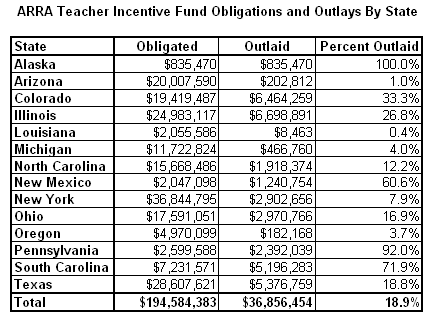
In contrast, Arizona’s award recipients had drawn down only 1 percent of their $20.0 million in ARRA TIF funds. A large chunk of these funds were awarded to Arizona State University for the Arizona Ready-for-Rigor Project which will also be supported by the Arizona Department of Education. Meanwhile, agencies in Louisiana had only drawn down 0.4 percent of its $2.1 million in awards. One of the largest recipients of TIF funds is the Louisiana Department of Education. According to a press release from the U.S. Department of Education, this grant will be used to implement the Teacher Assessment Program (TAP) in 70 high-need schools. It is difficult to determine why spending in these states has been so slow. However, it seems likely that state-wide programs, which received funding in both Arizona and Louisiana, may require additional coordination that has slowed down implementation for some grant recipients.
It is important to note that most of these funds are awarded to school districts or other organizations within a given state, not to the state itself. As a result, the entities spending these funds are not within the state education agency and associating a particular state with an expenditure amount obscures what is happening at the local level. Unfortunately, we cannot access good reliable information on how the local recipients actually spent these funds. Similarly, the Department of Education does not appear to provide a list of the recipients of ARRA-specific TIF funds. As a result, we cannot state with certainty which grant recipients are represented in the data above. It is also important to recognize that in most cases, the allocations listed above do not represent the total TIF funds allocated to agencies within a specific state. The 2010 TIF grant competition distributed $442 million in funding and the ARRA monies only make up $200 million of that total.
Clearly some of the grant recipients have hit the ground running, spending their ARRA TIF funds quickly, while others are taking longer to begin implementation and spending the funds. Combining the ARRA TIF funds with other regularly appropriated TIF funds has made it more complicated to track the expenditure of these funds and completely understand how ARRA monies have influenced the world of performance-based teacher compensation. Regardless, this particular source of TIF funding dries up on September 30th, 2011. Hopefully these grant recipients will be able to step up their spending so they can use all of the funds awarded to them. In the meantime, it would be ideal if the Department of Education provided more detailed information on the ARRA-specific TIF funds.
More About the Author
Issues
Related

Multilingual Students with Disabilities Deserve Stronger Support

University of Phoenix to Pay Up to $8.75 Million Over Claims It Shared Student Data With Meta

College Leaders View Economic Development as Central to Their Mission But Face Barriers, New America and ACCT Survey Find