
A Closer Look at Race to the Top Delays

Education stakeholders across the country have been closely following developments in the 12 states that received Race to the Top grants through the American Recovery and Reinvestment Act of 2009. Race to the Top (RttT) is a $4.35 billion competitive grant program to help states implement reform strategies focused on teacher effectiveness, standards and assessments, supporting struggling schools, and data usage. Since the awards were made in April and August of 2010, many winning states have been slow to draw down their Race to the Top funds. An Ed Week article published today highlights some of the reasons states have been sluggish in using those funds – many have submitted amendments to their RttT proposals slowing the pace of implementation, and others have not yet received approval for their “scope of work” plans from the U.S. Department of Education.
So far, the Department of Education has only approved “scope of work” plans for Delaware, the District of Columbia, Hawaii, Massachusetts, North Carolina, Ohio and Tennessee. This means that these states have the go ahead for implementation of their RttT plans including any amendments they may have submitted. As a result, it should come as no surprise that most of these states have spent slightly more of their funds thank those that have not had their plans approved. (As to be expected, Delaware and Tennessee – winners of the first round of the RttT competition – have spent the highest percentage of their awards. They received the funds five months before the winners of the second competition.) It also means that Florida, Georgia, Maryland, New York and Rhode Island are still waiting to receive approval for their scope of work plans, which explains why those states have barely spent any of their funds.
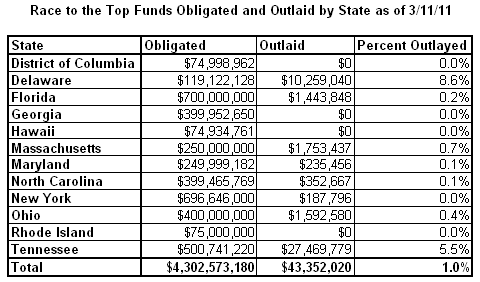
Six states and the District of Columbia have submitted amendments to their initial proposals. Though the Department of Education only posts letters indicating which amendments have been approved (so we can’t comment on what else the states have asked for but have been denied), these amendments give insight into the struggles states are facing as they implement RttT. These amendments primarily include scaling back planned programs, reallocating funds for different purposes or reassessing timelines for implementation of certain aspects of their applications. New political climates or timing issues have likely spurred these changes to their Race to the Top proposals.
The Department of Education indicates in each approval letter that the amendments are not expected to alter the scope or outcomes of the proposal. But this does not always seem to be the case. For example, North Carolina originally proposed to implement a retention bonus program for every new teacher in the state. Due to budget restrictions, however, the state has requested that this program be limited to a pilot program for 181 teachers each year. According to the National Center on Education Statistics, each school district in North Carolina hired an average of 66 new teachers in the 2007-08 school year. Given that there are 115 school districts in the state, this means that the state employs almost 7,600 new teachers every year. Based on these numbers, the pilot program would reach just over 2 percent of new teachers annually. Though this pilot will surely provide some important information on the efficacy of retention bonuses, it will not have the widespread effect initially intended in the Race to the Top application.
It is well known that many states have had trouble gaining political traction for their Race to the Top proposals and these challenges may partially explain the delays and amendments. In some states, the November elections brought in a new administration that disagreed with important parts of their proposals and sought to slow them down or change them. In other states, districts that initially indicated they would participate in the RttT effort backed out due to teacher union pushback or other influences.
Despite these obstacles, it is important that states hold up their end of the bargain and stay as true as possible to their Race to the Top applications. How far can states push the Department of Education until they refuse an amendment or rescind some RttT funds? Only time will tell.
More About the Author
Issues
Related

Multilingual Students with Disabilities Deserve Stronger Support

University of Phoenix to Pay Up to $8.75 Million Over Claims It Shared Student Data With Meta

College Leaders View Economic Development as Central to Their Mission But Face Barriers, New America and ACCT Survey Find