Laura Bornfreund
Senior Fellow, Early & Elementary Education

Earlier this month, I spoke on a panel titled “Teaching Teachers to Teach Reading” at the annual meeting of the Education Writers Association (EWA) conference in New Orleans. Here’s a quick recap:
The presentation gave me a chance to highlight findings from the Early Education Initiative’s latest report “Getting in Sync: Revamping Licensure and Preparation for Teachers in Pre-K, Kindergarten and the Early Grades,” emphasizing (for this particular panel) the differences in reading courses between K-5 and P-3 teacher preparation programs.
Our report found that today’s systems of teacher preparation and licensure are not set up to ensure teachers in pre-kindergarten through the third grades are well-prepared to work with young children.
In my presentation – now available here – I used a university in Georgia as one example of an institution that is teaching reading pedagogy in two very different ways – even though its students will eventually be teaching children in the same age groups. The university offers one reading course that focuses on pre-K through second grade and prepares prospective teachers to engage families in literacy, provides context for how young children’s language and literacy skills develop, and instructs soon to be teachers on how to grow emergent readers and assess the progress they make.
By contrast, the institution also offers a pre-K through fifth grade course that focuses more on preparing prospective teachers in instructional strategies to teach more than phonemic awareness, but also strategies to teach vocabulary, fluency, and comprehension. These topics were missing from the former course.
What I emphasize in “Getting in Sync”, and what the examples above reinforce, is that teachers of young children need instruction in and practical experience with all of these, and other, concepts. Prospective teachers need to understand how young children grasp new concepts and how to engage families in literacy. They also need to learn about strategies for teaching vocabulary and comprehension.
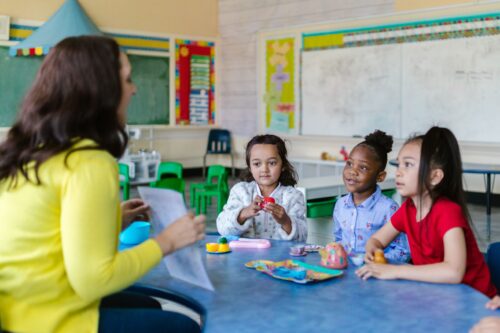
The panel discussion at EWA also featured Susan Burns, an associate professor at George Mason University in Fairfax, Virginia and Elanna Yalow, executive vice president of the early-learning provider Knowledge Universe. Much of the discussion focused on the importance of creating literacy-rich environments that give children access to fiction and non-fiction texts and feature classroom libraries that are within children’s physical reach, providing books that are both on children’s reading level and above their reading level. Panelists also talked about posting new vocabulary words in elementary school classrooms, labeling objects around the room (especially for new readers) and engaging children in conversation about unfamiliar and abstract concepts.
Senior Fellow, Early & Elementary Education