Jason Delisle
Director, Federal Education Budget Project

Negotiations between the White House and Congress over raising the debt ceiling appear to be moving forward—but with few details other than what congressional staff have scribbled on a cocktail napkin. Despite the lack of details, whatever legislation emerges to reduce federal spending (and raise revenue?) will likely impose caps on annual appropriations. Most education policy stakeholders have missed this key issue and what it means for federal education programs, focusing instead on the changes to federal student loan subsidies that are also imminent in any agreement.
Yet the cap on appropriations (i.e. discretionary spending) will have a pronounced effect on a whole range of education programs, from early education, to Title I grants for local school districts, to the Pell Grant program for college students.
Nearly every federal education program (except student loans and part of the Pell Grant program) is funded through the annual appropriations process. Funding for education programs – such as state grants under the Individuals with Disabilities Education Act – must be approved annually through an appropriations bill by the start of each new fiscal year on October 1st.
Before the appropriations process starts each year, usually in the summer months, Congress sets a one-year limit on total appropriations spending (called a 302(a) allocation) and the appropriations committees in the House and Senate aim to keep their bills within those limits. At least that is how things are supposed to work in theory.
The one-year appropriations limits aren’t really binding. That is, Congress can ignore them, and nothing happens if spending exceeds the limit. Furthermore, Congress typically sets a limit that makes room for new spending compared to the year before, taking some of the budgetary sting out of the limits.
The discretionary spending caps likely to come out of the debt ceiling talks are something entirely different. First and foremost, the caps would likely cut appropriations spending in 2012 and then put in place less-than-inflationary increases each year through 2015. Second, the caps would be enforced through something called a “sequester.” A sequester would require federal agencies to implement across-the-board spending cuts should Congress and the president enact a bill that spends more than the caps allow. (More on caps and sequesters here.) A similar arrangement was in place through much of the 1990s. Finally, the caps and the sequester enforcement would be signed into law, unlike the self-imposed appropriations limit Congress uses each year.
The table below shows a plausible scenario for discretionary spending caps that could come out of the debt ceiling talks. These caps would reduce federal spending compared to the Congressional Budget Office baseline estimate by about $230 billion through 2015. That’s about half of the $500 billion in spending reductions that negotiators are calling a “down payment.” But discretionary spending caps could account for even more in a final agreement. (Note that spending still rises ever year even under the caps. This is because when lawmakers talk about “cuts” they usually mean “slowing the rate of growth” in federal spending.)
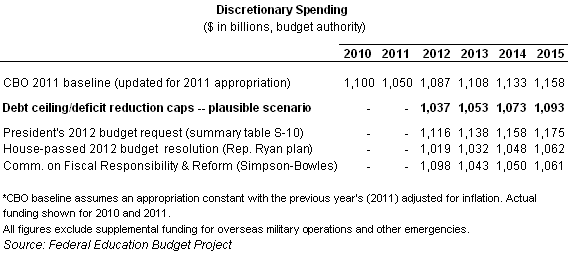
Education programs will likely feel a squeeze under these discretionary spending caps, as they will have to compete with all other agencies for what is now going to be a smaller appropriations pie. While it is possible that lawmakers will still boost education funding, other agencies will then have to bear an even bigger spending reduction to make up the difference.
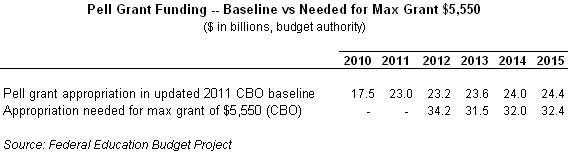
And let’s not forget the Pell Grant program. Because Congress has funded the Pell Grant program through all sorts of one-time supplemental funding efforts, lawmakers have needed only to provide a regular appropriation that covers two-thirds of the program’s cost, about $23 billion in 2011. But that regular appropriation is now baked into future spending assumptions, such as the CBO baseline and any discretionary spending caps under the debt ceiling agreement. That means the next five years could see Pell Grant appropriations of $23 billion annually, far short of the $34 billion needed to maintain the current maximum grant of $5,550.
In short, education stakeholders should be ready for leaner years ahead under discretionary spending caps. Moreover, the caps make a cut to the $5,550 maximum Pell Grant all but certain this year or next.
Director, Federal Education Budget Project