
Department of Education Tips Its Hat on Planned Sequesters, but Still Little Information Available

Members of the Senate Appropriations Subcommittee on Labor, Health & Human Services (HHS), and Education huddled today with Secretary of Education Arne Duncan and several school officials for a hearing to examine how sequestration – the automatic, across-the-board budget cuts coming in January – might affect education programs. Virtually everyone agreed: The impact on schools would be severe. Still, education stakeholders have been asking how sequestration might affect schools, and until this past week they lacked good estimates of those effects.
First, a quick review: Last summer, Congress passed the Budget Control Act, which required lawmakers to form a congressional “supercommittee” and hammer out a deal to reduce the deficit by at least $1.2 trillion over 10 years. The committee failed, and Congress didn’t pass any other deficit reduction package by its deadline, so federal agencies will be required as of January 2, 2013 to cut funding they will be allocated in a forthcoming fiscal year 2013 appropriations bill (Congress hasn’t passed the bill yet) by a uniform percentage. The supercommittee failure also triggered lower limits on future appropriations bills for the next eight years.
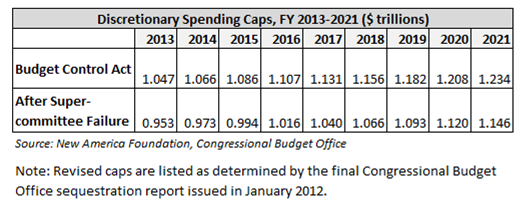
The automatic, across-the-board cuts are known as sequesters. Congress has previously used the device to enforce budget agreements, but in most cases, lawmakers have voted to “turn off” the sequesters before they take effect, rendering them moot. It’s still unclear whether Congress will pass a bill cancelling the cuts, or whether the president would sign such a law.
Perhaps most valuable for schools trying to plan ahead is the guidance that Deputy Secretary of Education Anthony Miller issued late last week to chief state school officers. That memo says that four programs – Title I grants, School Improvement Programs, special education Part B state grants, and Career, Technical, and Adult Education – that are funded though “advance appropriations” will actually be exempt until the 2013-14 school year. In other words, these programs have already been allocated a big chunk of fiscal year 2013 funding ahead of time and that funding is now exempt from the sequester in January.
That means schools will be spared cuts to those programs – which comprise most of the largest funding blocks in the Department’s discretionary budget – until the 2013-14 school year. Other federal programs will feel the cuts as soon as January 2013. As Deputy Secretary Miller said, schools will not have to lay off teachers or postpone hiring for the upcoming school year – and lawmakers have some time to find another workaround to the pending cuts.
There is one exception to the delayed effects of sequestration for education programs. The Impact Aid program, appropriated $1.2 billion in fiscal year 2012, is not funded with advance appropriations. It will therefore see the effects of sequestration as early as this fall. As one witness at today’s hearing pointed out, for some school districts Impact Aid makes up a huge portion of their budget. For those schools, funds will be affected for the 2012-13 school year, and the cuts would place a substantial hardship on those districts.
Stakeholders were also interested to hear Secretary Duncan give his best estimates of the Department’s plans for sequestration in today’s hearing. Pell Grants, he confirmed, would be exempt from sequestration. Other programs wouldn’t be so lucky. The Department will not have leeway to pick and choose which programs will be cut. The law is written such that virtually all Department programs will face across-the-board cuts. The Department’s current estimates, using a Congressional Budget Office estimate, is that the agency’s programs will be cut by 7.8 percent compared approximately to what they received in fiscal year 2012. That translates to $1.1 billion less for Title I grants, and $900 million less for special education state grants.
Chairman of the Subcommittee Tom Harkin released his own report ahead of the hearing. The report uses the same 7.8 percent estimated across-the-board cut to predict expected cuts to a variety of Department of Education programs, including $41.6 million from the school improvement grant (SIG) program, almost $90 million from the federal Impact Aid program, and $76.1 million from federal work-study grants for college and graduate students.
There are too many unknowns at this point to make accurate claims about the impact sequestration would have on school districts – for one, only the Senate Appropriations Committee and House Appropriations Labor-HHS-Education Subcommittee have passed fiscal year 2013 appropriations. So we don’t yet know from what level programs will be cut. And Congress may yet cancel the sequester in favor of a more generous budget for fiscal year 2013 (that could happen in the lame duck session Congress will hold between the elections and the 2013 presidential inauguration). But Secretary Duncan’s testimony and Deputy Secretary Miller’s issuance give the first inside look at the planning for sequesters happening inside the U.S. Department of Education.
More About the Author
Issues
Related

Current Head Start Program Performance Standards Protect Children with Disabilities

New Report Offers Bipartisan Solutions to State Child Care Woes

Tracking the AI Economy: Seven Charts Every Presidential Candidate Should Study