
Federal Funding Update: A Stop-Gap Measure for 2013 And Looming Cuts from Sequestration

Clare McCann
This post originally appeared on Early Ed Watch.
The Senate is expected to vote this week on a continuing resolution (CR), already passed by the House of Representatives, that will continue to fund the government through March 2013. That means that, beginning with the start of the fiscal year on October 1, 2012, all education and early childhood programs will be funded at the same levels they received last year, plus a marginal 0.612 percent across-the-board increase.
The continuing resolution forestalls any government shutdown threat and lets lawmakers leave town on schedule before the elections. Unless legislators decide to take on 2013 appropriations in the lame duck session of Congress between the elections and the swearing-in of the new Congress, it also puts the responsibility for passing full appropriations bills in the lap of the next Congress.
But there is one looming issue the CR does not address: sequestration. The Budget Control Act of 2011, which laid out discretionary spending limits for fiscal years 2012 through 2021, also included this element, also ominously called “the sequester.” The Budget Control Act said that if an appointed congressional supercommittee failed to agree on substantial spending cuts, fiscal year 2013 funding would be rescinded – sequestered – and future-year spending caps would be lowered to find the $1.2 trillion in savings. As most people following the budget know well, the supercommittee did, indeed, fail, and sequestration now looms.
The CR’s only mention of sequestration is to require each of the departments and agencies included in the appropriations bill to submit two reports to the House and Senate Appropriations Committees. The first report, due within 30 days of the CR’s enactment, shows program-level funding under the CR. The second, within 30 days of any sequestration issues (meaning the end of January), shows the sequesters’ cuts at the program level.
Outside of the CR, last week brought other news of the impact of the sequesters. A report from the White House Office of Management and Budget (OMB), mandated by Congress in the Sequestration Transparency Act of 2012 passed in August and released Friday afternoon, estimated the size of the sequesters by program office. The OMB calculations show that nondefense discretionary spending (including Head Start, Title I, special education funding, and other critical programs) will be cut by 8.2 percent. Nondefense mandatory programs like the home visiting program and the Social Services Block Grant will be cut by 7.6 percent. (The mandatory portion of the Child Care and Development Block Grant program is exempt under a low-income beneficiaries exemption.)
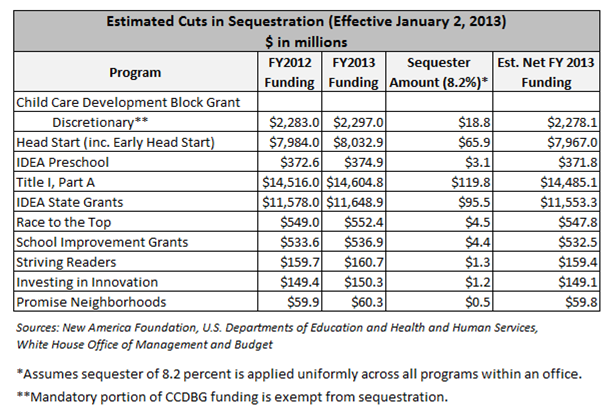
The OMB figures, although they don’t drill down to the program level that Congress had requested, are higher than previous Congressional Budget Office estimates had suggested (7.8 percent each for nondefense discretionary and mandatory spending). And they do give us a better idea of how sequestration will impact early childhood programs. For a look at how sequestration could affect school districts across the country, check out this post from our sister blog, Ed Money Watch.
But Congress may not be resigned to sequestration just yet. Lawmakers have until the New Year to cancel or postpone the sequestration legislatively – and since few people really want the cuts to take effect, a fix for sequestration may take priority in the lame duck session. Check back with Early Ed Watch as the sequestration deadline approaches for updates.
Issues
Programs/Projects/Initiatives
Related
Federal Early Education Update: September 2026

Five Things States Can Do to Support High-Quality Kindergarten and the Early Grades