
Murray Budget and Student Loans: Where’s the Money?

Education advocates have been lauding the budget resolution wending its way through the U.S. Senate. They praise the Senate budget resolution (aka the “Murray budget,” so named for Budget Committee Chair Patty Murray) for rolling back the increases in origination fees for student loans and for addressing the July 1 expiration of the 3.4 percent interest rate on Subsidized Stafford loans for undergraduates. These advocates have either been duped or are simply giving Senate Democrats a free pass: The Murray budget does not include funding for any changes to student loans – or any education programs on the entitlement side of the budget, for that matter.
Congressional budget resolutions are drafted each year by the House and Senate Budget Committees to set spending and revenue targets for at least the next five years. The budget resolution is broken down into budget functions that help set the limits on future spending for different agencies.
Each budget function has a “baseline funding” level, which refers to current law. If senators intended to leave education programs exactly as they are under current law, senators would set funding at the baseline in the budget resolution.But if the senators drafting the budget resolution want to “make room” for more spending on education programs like student loans – say, to extend the 3.4 percent interest rate on Subsidized Stafford loans – then the budget function for education (function 500) needs more funding in it than the baseline.
So if the Murray budget was serious about making changes to education programs, we could look at the education budget function and we would see an increase in funding above the baseline. For example, a one-year extension of the 3.4 percent interest rate on Subsidized Stafford loans would cost about $6 billion above baseline. But there is no such funding increase in the Murray budget. Education funding is exactly at baseline, and no additional funding is provided for education programs on the mandatory side of the budget, such as student loans (see table below).
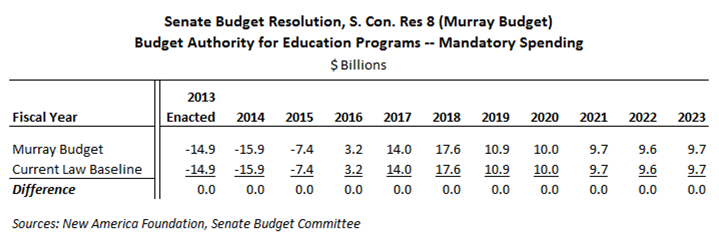
Why did Senate Democrats opt not to include the additional funding in the budget resolution? Because that would have showed up as additional spending. Instead, the Senate Democrats included a “deficit-neutral reserve fund” for higher education programs that includes no spending numbers whatsoever. Why? Because that approach includes no spending numbers whatsoever. That way the budget resolution can have its cake and eat it too. Its supporters can boast about new spending for student loans but exclude that spending from any actual spending number in the budget resolution.
That is a convenient trick if you can get away with it. Education advocates seem willing to play along with a wink and nod – or maybe they have been duped. Perhaps they should ask Senate Democrats to show them where the money is for more spending on student loans. And remember, spending is measured in numbers, not words. Do not fall for the “reserve fund” trick.
Issues
Related

Rethinking the College Premium in the Age of AI

CCAMPIS Changes Put Politics Ahead of Student Parents