
The Sad State of Child Care in America

In “The Hell of American Day Care,” a piece published by The New Republic on Monday, journalist Jonathan Cohn highlights one particularly devastating example of low-quality child care. Four children died in a house fire that took place at a day care program in a private home, while the proprietor, Jessica Tata, was allegedly shopping at a nearby Target and Starbucks, leaving her young charges alone. Tata was sentenced to 80 years in prison. A Texas child care inspector interviewed for the article said that knowing how unsafe many day cares are, even those certified by the state, she would trust her own child to only 20 percent of the area’s programs.
According to a new report from Child Care Aware of America, the inspector may be right. The publication, “We Can Do Better,” evaluates state policies on child care and assigns each state a score. This year, no state scored above 87 percent, and the lowest-ranked state, Idaho, rated only 15 percent. Texas was actually ranked in the top 10 states, at 82 percent. But, as Cohn’s story explains, child care centers in Texas are inspected only once a year, and home day care centers only every other year.
Child Care Aware analyzed state policies on safety, teacher and leader education and training, quality standards, accountability and transparency and licensing. Eight states scored below 50 percent on the safety and quality program requirements the group set forth, and only three states – Massachusetts, New Jersey, and Wisconsin – scored above a C grade.
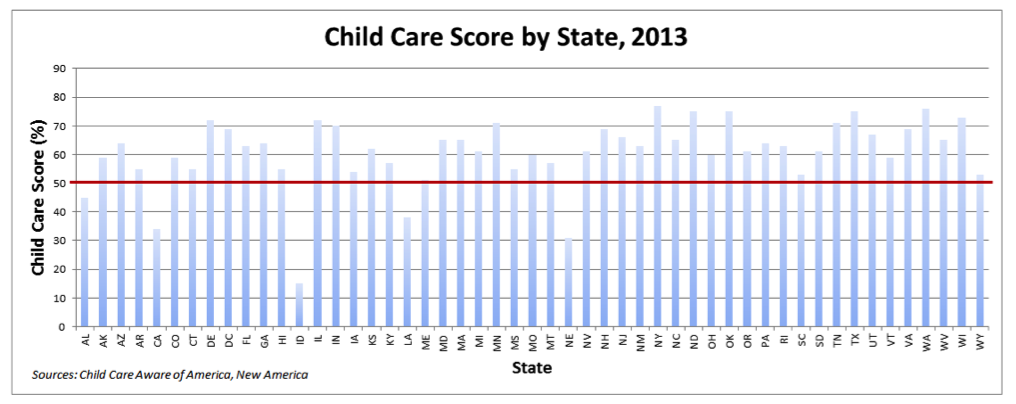
Moreover, few states met Child Care Aware’s standards for program oversight, including state inspections of child care centers, regulating the workloads of licensing staff and making inspection reports and complaints available to parents. Fifteen states scored below 50 percent. In 19 states, the report finds, budget woes have led to growing staff caseloads; Oregon, for example, increased the number of programs inspected by each staff member by 80 percent since 2011. And only five states – Michigan, New Mexico, North Carolina, Oklahoma and Tennessee – require licensed child care programs to participate in the state’s quality rating and improvement systems.
The federal government provides funding for child care subsidies to low-income parents, primarily through the Child Care and Development Fund (CCDF). At $5.2 billion, CCDF is funded in part with mandatory federal funding and in part with Child Care and Development Block Grants provided through the annual congressional appropriations process. Congress recently restored $50 million to the program in the continuing resolution it passed for the second half of fiscal year 2013, reducing the sequestered amount of child care funding by about half.
But despite federal and state funding, 22 states had waiting lists for child care assistance in 2011. In many states, families receiving child care assistance and even middle-income families cannot find or afford high-quality care for their children. Another report from Child Care Aware found that in 2011, center-based infant child care exceeded the cost of in-state tuition and fees at four-year public colleges in 35 states and the District of Columbia.
The president’s 2014 budget request included a $700 million increase for child care spending under CCDF, $200 million of which would help states improve the quality of child care providers through quality standards, better monitoring and professional development. The president also proposed a $1.4 billion Early Head Start-Child Care partnership program to expand access to high-quality care. But that’s a far cry from what states would likely need to provide high quality care to all the children they currently serve, not to mention expanding care.
The Jonathan Cohn piece shows why safe, high-quality child care matters, and the statistics in the Child Care Aware report on state child care policies are sobering. More than a decade overdue for reauthorization, the Child Care and Development Block Grant should be reviewed and revised by Congress this year, and any new version of the law should do more to ensure safe, high-quality learning experiences for low-income children.
Attachments:
Issues
Programs/Projects/Initiatives
Related
Federal Early Education Update: September 2026

Five Things States Can Do to Support High-Quality Kindergarten and the Early Grades