
New Report Explores Federal Opportunities to Promote Data in Classrooms

Today, the New America Foundation’s Education Policy Program released a new report, Promoting Data in the Classroom: Innovative State Models and Missed Opportunities. Please click here to read the report.
Over the past decade, states and school districts across the United States have collected huge amounts of data on students’ academic achievement, teachers, and academic environments. Every state maintains a student-level longitudinal data system, and education stakeholders in school districts across the country have innumerable facts, figures, and statistics at their disposal. But most states don’t do much to train teachers in using these data to inform and improve classroom instruction.
In a report released today from the New America Foundation’s Education Policy Program, we examine two states—Oregon and Delaware—that are bucking that trend and working to equip teachers with the skills they need to analyze student data and to apply it in the classroom. Both states are using federal funds to implement their plans, and they can be models for other states seeking to make relevant the many data points they collect each year. But for federal policymakers, the most valuable lessons may come from the funding each state used.
Oregon DATA Project
Oregon launched the Oregon DATA Project (ODP) using funds from the Statewide Longitudinal Data Systems (SLDS) grant program in 2007. The plan was designed to help teachers use student data, particularly state standardized test scores, to identify which students were falling behind and provide them with the interventions or extra tutoring they need.
It’s run by virtually all volunteers from across the state, and brings teachers from around the state together. Volunteer data coaches learn to work with the data, and then take it back to their schools’ Professional Learning Communities (PLCs, small-group meetings in which educators collaborate to analyze data and learn new skills).
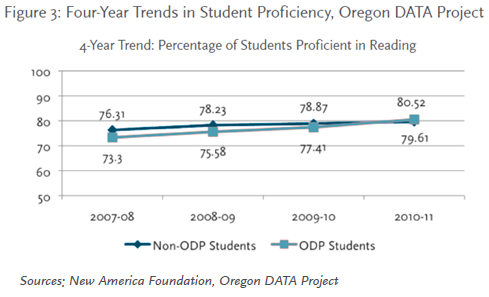
An independent evaluation has revealed some early successes – an achievement gap between ODP and non-ODP students in the first year of the project has disappeared, and in 2011, ODP students surpassed non-ODP students in reading for the first time.
Delaware Data Coach Program
The Delaware Data Coach Program uses many similar constructs to the ODP, but it was instead included as a part of the state’s Race to the Top (RttT) grant award. The program contracted with an outside group, Wireless Generation, to provide data coaches. And whereas ODP is an all-volunteer project, the Delaware Data Coach Program is mandatory for all core subject teachers in grades 2 through 12 – though all public school teachers, including kindergarten and first grade teachers, have elected to participate.
Delaware teachers also joined Professional Learning Communities. In some school districts, PLCs were already in place before the RttT award. Where the PLCs were already robust, the program leaders reworked the data coach model so that the outside data coaches were instead training the identified teacher-leaders in the school. In fact, the data coaches were meant to be temporary – the RttT application permits for two years of data coaches in the middle of the four-year grant, after which the coaches will have “coached themselves out of a job.”
The state hasn’t released an evaluation of the program’s impact on student achievement yet, but a survey of participants shows that 87 percent of teachers believe student data can offer information critical to differentiated instruction – and nearly 60 percent are more confident using data to make instructional choices, thanks to the PLCs.
Federal Policy Implications
The Oregon and Delaware projects have a lot in common. Both used PLCs during the regular workday to bring teachers together in a collaborative, open format. Both relied on data coaches to bring teachers up to speed on the data skills they’d need. And both found the presence of administrators who bought into the project was critical.
But the Oregon and Delaware data programs came from entirely different sets of funds. Though both used federal dollars, they relied on competitive grant competitions. Scaling these projects out to other states, then, will require a broader funding base. The Improving Teacher Quality State Grants program, a formula-funded program that provides money to every state, every year, holds large potential.
The New America Foundation’s report, Promoting Data in the Classroom: Innovative State Models and Missed Opportunities, explores two states’ efforts to bring data to teachers, describes the obstacles and successes that Oregon and Delaware have each faced, and provides recommendations to federal policymakers who hope to expand similar efforts to teachers across the country. Click here to read the full report.
Issues
Related

CCAMPIS Changes Put Politics Ahead of Student Parents

Five Things Principals Can Do to Protect Kindergarten’s Three Indispensables