Pairing Investments in College Access with Investments in Early Education

My hometown, Kalamazoo, Michigan, made waves in 2005 when the superintendent of the local public school system announced that anonymous donors had established a fund to cover the college tuition of every Kalamazoo Public Schools graduate in perpetuity. The program, known as the Kalamazoo Promise, attracted the attention of national news outlets (NBC Nightly News, CBS Evening News, and the New York Times, among others). Since its inception, community leaders have realized that it’s not enough to make college more affordable and accessible – students need high-quality PreK-12 instruction to be adequately prepared for college. Recent research shows that one of the community’s signature early education initiatives, Ready 4s, substantially improves students’ chances for long-term academic success.
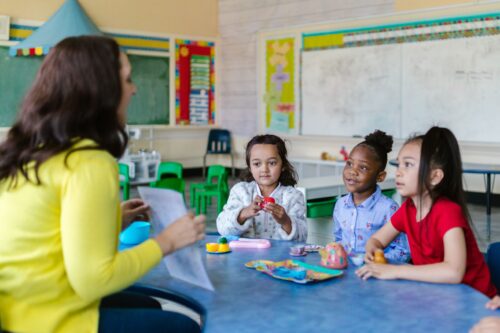
In 2011, a number of public, private, and non-profit community stakeholders formed Kalamazoo County Ready 4s, an organization with the mission of expanding access and improving the quality of preschool education in the area. What’s more, while the Promise program applies only to students within Kalamazoo’s city limits, Ready 4s is a county-wide effort. The big question, of course, is whether these early education investments are showing returns.
Dr. Tim Bartik, Senior Economist at the Upjohn Institute, recently published a paper showing that KC Ready 4s has substantial effects on student outcomes. Based on pre-test and post-test data on KC Ready 4s students, he found that it “appears to increase student learning during the year before kindergarten by 55–86 percent.” Bartik estimates that this will work out to a $23,000 increase in future adult earnings—a 5:1 return on the $4,500 program cost for one student. He notes that this ratio probably underestimates the program’s return, as it does not account for reductions in crime, special education placements, and “other remedial education costs.” (Here’s an Early Ed Watch post that offers some context on pre-K programs’ rates of return.).
Most families don’t pay that $4,500 sticker price—KC Ready 4s employs a sliding scale of tuition subsidies. Next year, families making less than $50,000/year will have their tuition fully subsidized, and families making between $50,001 and $70,000 will be 98% subsidized. KC Ready 4s currently gets funding from private donors, but the group is exploring ways to “braid” its funding with local Head Start providers and Michigan’s “Great Start Readiness Program” (a recently expanded state preschool program).
The next—and perhaps bigger question—is whether these gains will hold up over time. Can KC Ready 4s help more Kalamazoo students succeed in college with the support of the Promise program? Bartik noted in an email that he plans to follow the KC Ready 4s students’ progress over the coming years: “Of particular interest is not only how KC Ready 4s affects test scores, but [also its] effect on special education enrollment, as this would provide some monetary savings to offset pre-K costs.” Between this investment in early education, Michigan’s recent pre-K expansion, and the Promise, Kalamazoo’s model could be a guiding example for other communities seeking to improve their students’ college readiness.
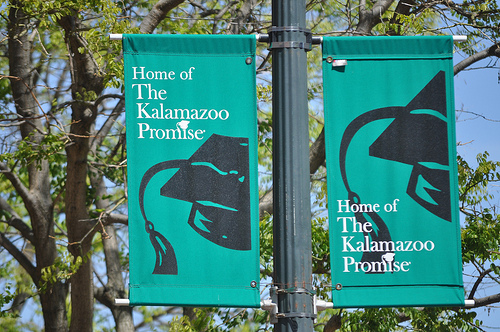
Image Credit: Flickr via Michigan Municipal League
Issues
Programs/Projects/Initiatives
Related
Federal Early Education Update: September 2026
Five Things States Can Do to Support High-Quality Kindergarten and the Early Grades