Ken Sofer
Summer Fellow, Resource Security Program
Reexamining cereal price spikes and food-related instability over the past 25 years.
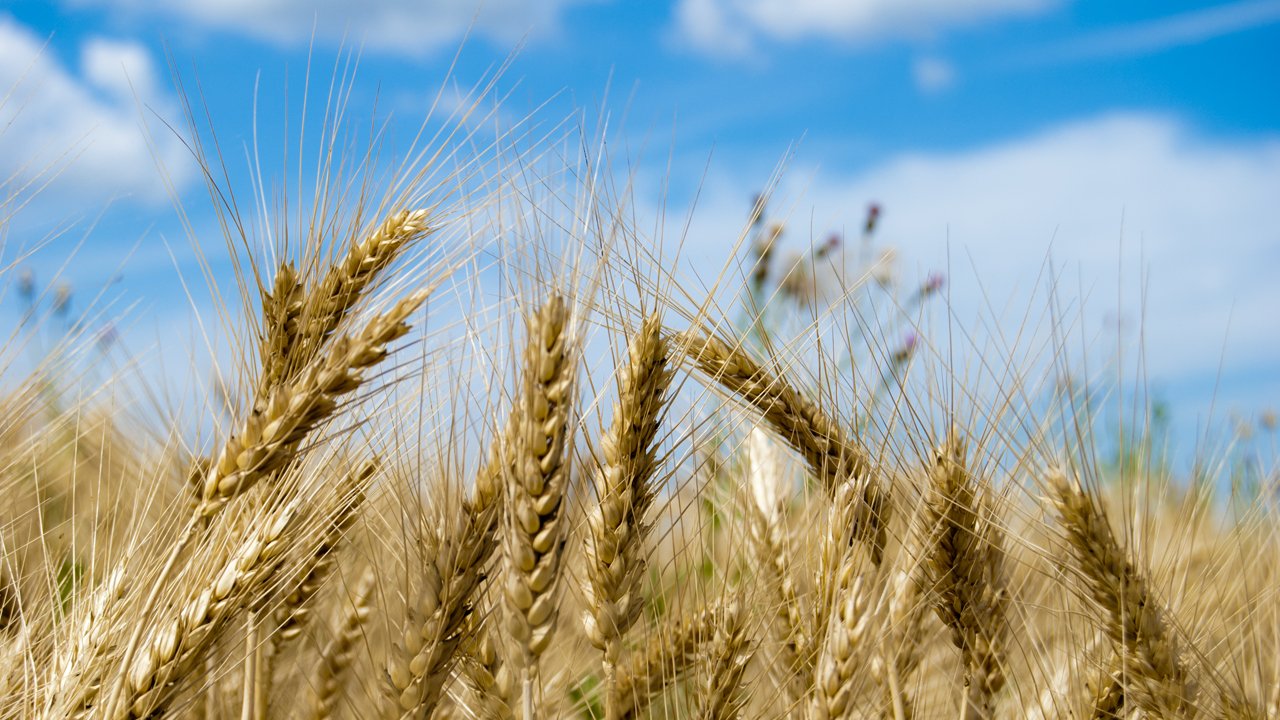
“Bread or blood!” the women chanted as they looted shops, caravans, and warehouses in search of flour, beef, and bacon. Food prices in the short-lived Confederate States of America increased ten-fold from 1861 to 1863, until tensions boiled over into the Richmond bread riots that winter.
The ties between food prices and public frustration are well-documented, and increasingly there’s an understanding that food security can be a significant factor in social instability. Here at Natural Security, we’ve covered the impact of food price increases in South Sudan and Venezuela with a particular emphasis on how food shocks can exacerbate already fragile economies and societies.
In my post on the drought in California’s Central Valley, I wrote about why the inelasticity of demand for staple crops like wheat, corn, and rice make these prices changes so much more impactful than price changes for fruits or vegetables.
Since 1990, there have been four major spikes in the Cereal Price Index, which factors in a range of wheat, maize, and rice prices. Below is a chart showing monthly global cereal prices from January 1990 to June 2016 based on data from the UN’s Food and Agriculture Organization.
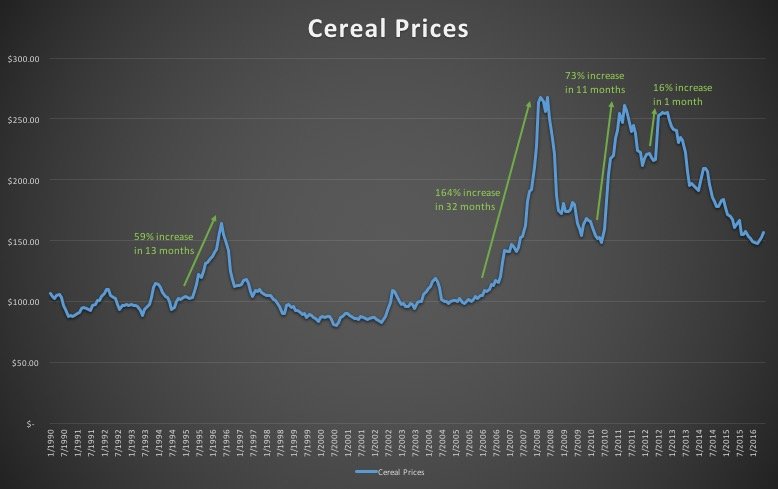
The two biggest price increases in absolute terms are the 2006-2008 and 2010-2011 crises. These two periods have been studied at length in part because of the series of food riots that broke out around the world in response.
During the 2006-2008 period, riots and protests took place in more than 15 countries from Latin America and Africa to the Middle East and Asia, including Haiti, India, Burkina Faso, Yemen, Senegal, Mozambique, Cameroon, and Côte d’Ivoire. The 2010-2011 food crisis is a dominant theme in retrospectives on the Arab Spring protests that erupted across the Middle East in early 2011, particularly in Egypt, the world’s biggest importer of wheat.
But the other two major price spikes don’t get much attention due to the lack of widespread bread riots. There were some protests in Jordan in 1996, but nothing approaching the scale of global unrest in 2008 or 2011. Egypt had major anti-government protests beginning in late 2012 that eventually unseated President Mohamed Morsi, but wheat prices weren’t considered a major factor in the protests at the time.
A few theories about why the 2006-2008 and 2010-2011 price spikes were so different than the 1995-1996 and 2012 price spikes:
Sharon adds another valuable hypothesis for why these price spikes produce such uneven results:
The greater role of food security, and subsequently food prices, in the conversation around international stability, conflict, and security is unquestionably positive, but simply looking at global prices isn’t enough to predict conflict. Unless protesters explicitly shout “Bread or blood!” like the angry Confederates did in 1863, it’s also hard to measure the role of food prices as a direct cause for social upheaval. Understanding the role food price will play in the next Arab Spring will require studying the issue at multiple layers: the economic and the psychological; the short and the long-term; the local and the global.
Summer Fellow, Resource Security Program