Mattis on Military Energy Security
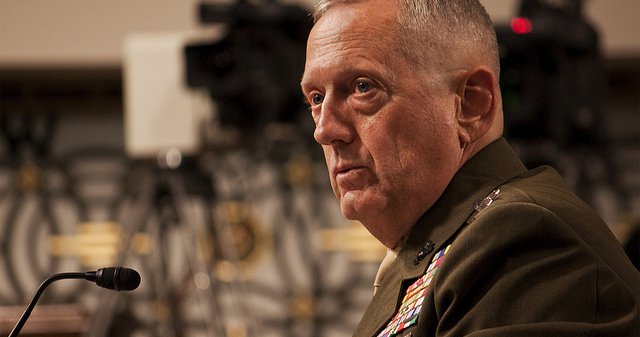
In yesterday’s hearing on the nomination of General Jim Mattis
(USMC, ret) to be Secretary of Defense, Senator Jeanne Shaheen asked about
military energy policy. You can watch her posing the question on C-SPAN,
and I’ve copied in the transcript below, also courtesy of C-SPAN.
Now, General Mattis did not say much on the subject, beyond that
he generally thinks a sound energy policy is a good idea and the private sector
is interesting. If that left you feeling a little hungry for more, you can take
a look at the General’s answers to the Advance Policy Questions, also copied in
below. APQs, if you’re not familiar with them, are questions senators may pose
to the nominee before the hearing, and you can find all 227 (or so) of them at
the Senate Armed Services Committee website.
These questions cover everything from space satellites to Syria
to sexual assault, an impossibly broad range of topics. Generally speaking, the
Department will give the questions to the appropriate Pentagon offices and
direct them to prepare answers, which will then be submitted to the transition
team (or the legislative affairs office after the inauguration). The nominee
then will accept or edit the answers, or write his or her own. Generally, the
transition team (or legislative affairs shop and/or Secretary and his principal
officers and/or the White House) will review the nominee’s answers and may
recommend changes. In this case, I would guess that General Mattis either wrote
most of the answers himself or scrutinized them very carefully. From his
keyboard to your eyes.
I found no surprises in his answers on energy (see my blog
about General Mattis if you want to know what I expected). But it was nice to
see him explicitly point to the importance of incorporating energy performance
into the acquisition process, whether he wrote that himself or validated the
good work of the Operational Energy team in the Office of the Secretary of
Defense by accepting the language. If you’re interested in doing energy
business with the Pentagon, I would say take him at his word when he says
defense energy investments will have to show how they support the Department’s
missions, as well as the return on investment, connection to national security,
and support for combat readiness and reduction of risk to fielded forces. This will be true for investments at fixed
bases, as well. His testimony yesterday and the very last line of the APQs
suggest he will give guidance to emphasize commercial technologies that can be
adapted for DoD use, rather than bespoke technology development.
Questions for the Record (QFRs) from senators will follow, and
there will most likely be more energy questions — and climate change questions
as well. Stay tuned!
Clip
from transcript of nomination hearing for General James Mattis to be Secretary
of Defense. Senate Armed Services Committee, January 12, 2017:
Senator Saheen: Thank you, Mr. Chairman. Welcome, General Mattis. And thank you for your willingness to continue to serve this country. I have read that in 2005, as Commander of the Marine Corps Combat Development Command, that you asked researcher to, quote, unleash us from the tether of fuel and explore ways to improve the efficiency of military vehicles in order to reduce the strain that energy put on supply lines. Because you not only when you commanded the First Marine Division during the 2003 invasion, but you had also seen what happens when our troops outran their fuel supplies. So can you speak to why you think this is important? And will you as Secretary of Defense continue to support the military’s effort to pursue alternative and more efficient sources of energy to reduce our reliance on conventional fuel supplies?
General Mattis: Yes Senator, we will take advantage of every advance in terms of extending our legs extending our energy efforts, and certainly there’s a lot of progress that’s been made. I’ve been living in Silicon Valley for the last several years, so you can understand my interest in what they’re doing out there in the private sector.
Advance Policy
Questions for General James Mattis, Nominee to be Secretary of Defense,
January 2017.
During your time in Iraq, you called on the Department to
“unleash us from the tether of fuel.” What exactly did you mean and what
experiences led to that comment?
I meant that units would be faced with unacceptable limitations
because of their dependence on fuel, and that I wanted to be able to push those
limits further. Meanwhile, our efforts to resupply the force with fuel made us
vulnerable in ways that were exploited by the enemy.
Do you believe this issue remains a challenge for the Department
of Defense?
Yes.
If confirmed, what will you do to unleash the Department from
the tether of fuel?
The Department’s acquisition process should explore alternate
and renewable energy sources that are reliable, cost effective, and can relieve the
dependence of deployed forces on vulnerable fuel supply chains to better enable our
primary mission to win in conflict. The purpose of such efforts should be to increase the
readiness and reach of our forces.
If confirmed, what priorities would you establish for Defense
investments in and deployment of operational energy technologies to increase the
combat capabilities of warfighters, reduce logistical burdens, and enhance
mission assurance on our installations?
Investments in energy technologies should be prioritized
according to the same standard as any other Department decision to invest in basic
research and technology development, namely: their direct contribution to achieve the
Department’s primary missions; potential return on investment; protection of US
national security interests; and contribution to
enhancing readiness and combat effectiveness while reducing the vulnerability
of our service members in battle. We should also take full advantage of private
sector innovations that can provide military advantages.
More About the Author
Related
Climate Security: Building a Community of Practice

Climate Change, Peace and Security, and the UN Group of Friends

Infrequently Asked Questions