Expanding the Table
Millennials aren’t just asking a seat at the table - they’re expanding it
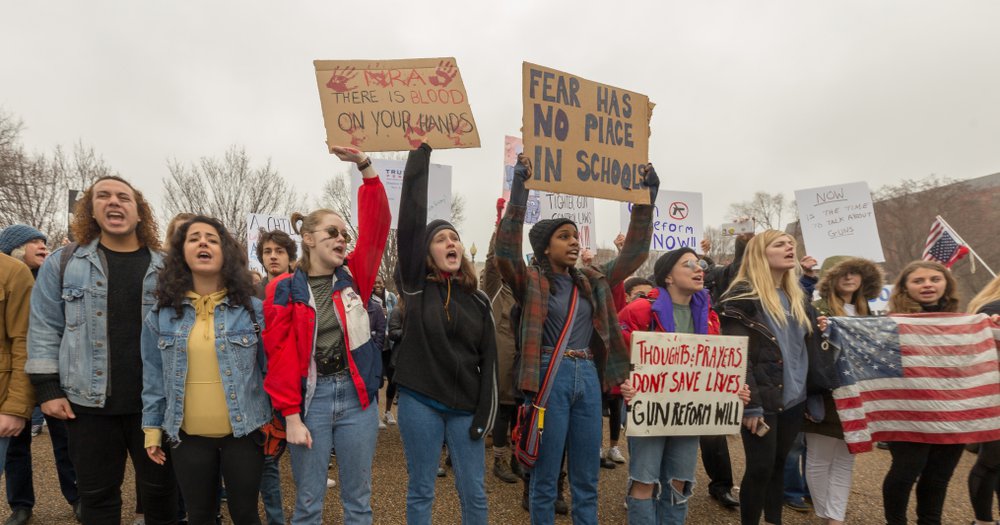
Though the massacre at Marjory Stoneman Douglas High School in Parkland, Florida took place in February, it is already receding into the past. There is a near irresistibility of our media landscape to move on to the next calamity or the next development within the ongoing sagas of our current political moment. However, it might be instructive to realize that while the media coverage might have waned, the activism sparked and led by Marjory Stoneman Douglas High School students has only just begun.
There are national marches planned for the month of June as a follow-up to the March for Our Lives that took place in April. The Marjory Stoneman Douglas High School students have themselves began conducting voter registration drives to realize a formal kind of political power at the ballot box that has, at least up until now, remained informal. And beyond the direct politicization of the Parkland students, there is a slowly growing, yet unmistakable, shift for young people’s political engagement.
Indeed, over a year before Parkland, the 2016 presidential election served as an inflection point for young people, with the GenForward Survey reporting that a majority of young adults in every major racial and ethnic group claiming to have participated in at least one political activity since the election.
There is a slowly growing, yet unmistakable, shift for young people’s political engagement.
It was in this spirit that the final session at New America’s Millennial Public Policy Symposium, “Expanding the Table: Intergenerational Activism and Policy Change,” was held. By highlighting the work of activists on-the-ground, “Expanding the Table” was designed to show that young people aren’t waiting for permission to engage with politics. As a result of this more unrepentant activism, the cast of characters that enters into the ever-expanding “political” space is more diverse and more unapologetic than ever.
As the session progressed, each panelists touched on the tension between self-advocacy and the needs of those with more social power and influence to also step in and stand up for the issues critical to young people. Tatiana Benjamin, an American Studies PhD from the University of Maryland, identified the fact that the burden of social justice can not completely be borne out by those who are the most marginalized. She shared the story of deportation within her own family and community and how having access to nationalistic privilege spurred her to organize around issues of undocumented Black communities. Similarly, panelist Sumi Yi from National Korean American Service & Education Consortium, or NAKASEC, recounted a story of hearing about the struggles of living with Deferred Action immigration status from a close friend that led her to join the organization.
What kinds of voices would be necessary to even begin to capture the activist orientations of young people at this political moment?
It is important to note that the event was crafted out of a desire to think about what kinds of voices would be necessary to even begin to capture the activist orientations of young people at this political moment. Elevating the voices of three women of color all representing issues that highlight the intersections of issues that cut across various populations of young people is instructive. As Split this Rock poet-activist Asha Gardner remarked, it was having her voice centered by those that she looked up to as poets that both inspired her and gave her the efficacy to step into leadership and support the development of other young people’s critical consciousness.
The key points of political contention that activate the young electorate are shifting and expanding over time. Issues such as immigration, racism, net neutrality, and environmental degradation, and, even more specifically, how the consequences of those issues are meted out to different marginalized populations are creating the raw material for organizing young people. While no generation is ever single-issue, the activists on stage argued that all issues are intersectional and cross-cutting.
Culture change is not separate from policy change, but in fact emerges in tandem with it.
This foregrounding of multifaceted issues speaks to a larger, critical point that they all spoke to in one way or another and was described explicitly by the moderator, Millennial Public Policy Fellow Roselyn Miller. Culture change is not separate from policy change, but in fact emerges in tandem with it. That young people are not waiting or asking permission is important because it speaks to cultural shifts, but rather the role of public policy is to facilitate that agency and to help develop it.
How do we, as the session description stated, practically build movements of change? An answer gleaned from the event’s powerful conversation is that we must understand and remember that lasting change and purposeful, impactful movements are loud, inconvenient and insistent on their righteousness. Millennials (and younger folk) are showing this more and more.
This blog is part of Caffeinated Commentary – a monthly series where the Millennial Fellows create interesting and engaging content around a theme. For May, the fellows are recapping some of the many important conversations from their April Millennial Public Policy Symposium: New Voices and Ideas on Care, Community, Technology, and Civic Engagement.
More About the Author
Issues
Programs/Projects/Initiatives
Related
The Millennial Money Myth

Online, Vulnerable Groups Only Become More Vulnerable

One Year Later: Reflecting on the Millennial Public Policy Fellowship