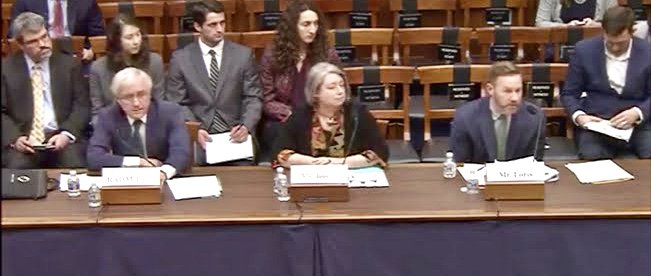
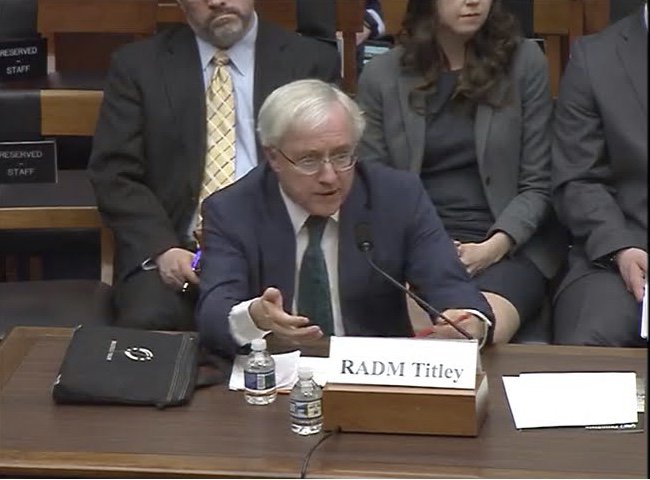
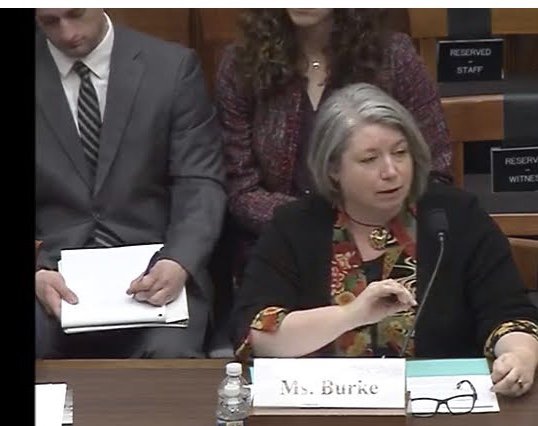
Yesterday, on March 13, 2019, I testified in front of the House Armed Services Committee's Readiness Subcommittee, along with the great Rear Admiral (ret) David Titley, a Phase Zero advisor, and Nick Loris of the Heritage Foundation. Rep John Garamendi (D-CA) is the Chair, and Rep Doug Lamborn (R-CO) is the Ranking Member. I had actually appeared in front of that subcommittee before, as an Assistant Secretary of Defense, in a highly acrimonious hearing. Yesterday could not have been more different. The 116th Congress is a breath of fresh air — all of the Members, on both sides of the aisle, were civil, engaged, and very well informed. I was absolutely delighted to see so many new female Members in the majority, and they were impressive — including Elissa Slotkin, a former Pentagon colleague and always a star, now ably representing the people of her home state of Michigan. We were calling for better integration of climate security and energy security into the business of the Pentagon, including improving the resiliency of military bases — and there was agreement about the importance of these issues among all witnesses and all Members. What hit me was that I've been conditioned to be defensive in front of Congress — and now it's time to be ambitious. My prepared statement was entered into the record, and we posted it yesterday. Below is the verbal statement I put together, which is different from the longer statement for the record. I didn't deliver every word of it — you get five minutes for an opening statement, and it goes by very fast — but this is what I planned to say.
Thank you, Chairman Garamendi, Ranking Member Lamborn, and Members of the Subcommittee, for the opportunity to appear before you today.
My name is Sharon Burke, and I direct the Resource Security program and Phase Zero Project at New America. I should clarify that I speak only for myself today — New America does not take corporate positions, and I do not speak for the Department of Defense, nor are they able to necessarily vouch for what I say.
Of course, I did once speak for the Department, at least when it came to my portfolio as the Assistant Secretary of Defense for Operational Energy. In that capacity, I had a chance to travel to Afghanistan with military logisticians, and on one of those trips, our Protocol officer, who knew I wanted to see some real housing, took me to see her own CHU in Kabul. This was a full bird colonel, mind you, and she was sharing a dingy, rattling compartment so small I could nearly touch both walls. There was a faded Uncle Sam poster down the hall that said “Don’t waste energy. Turn off the lights.”
I tell you this not to suggest that this subcommittee needs to rush out and build McMansions on forward operating bases — I never met anyone in uniform who really wanted a flat screen TV in every tent. They know they’re at war. I tell you that story because when it comes to energy and climate change — it has to be more than poster on the wall.
Our troops should know instead the opportunity cost for the force’s immense energy footprint – there was a strategic cost, for example, as we trucked Russian fuel through all of Central Asia, which helped destabilize the government of Kyrgyzstan, according to an investigation by this body. There was a tactical and operational cost as combat patrols, convoys, helicopters, and C-130s delivered or protected fuel, instead of conducting other missions. There was a human cost in lives. And these sorts of missions require far less fuel than would, say, maneuver warfare on the Korean Peninsula or any contingency in the Asia-Pacific, with its vast distances. And there are potential adversaries there who are capable of far more lethal, precise, and far-ranging attacks than an IED or a weaponized human body. Moreover, the United States increasingly has an electrified force, which introduces an entirely new attack surface, one that the Department of Homeland Security and the FBI have publicly warned the Russians are seeking to exploit.
The Department of Defense should increasingly take energy resilience into account as a planning factor and a capability enabler. Moreover, the gravity of military needs can provide a natural pull for innovation. A lower requirement for resources, particularly fuel and water, for example, means a more logistically sustainable operation with fewer soft, supply targets for adversaries to strike.
When it comes to fixed installations, as the Members of this Subcommittee know very well, in the digital age, they are increasingly “platforms” that directly support military operations. They shouldn’t be seen as dispensable overhead or some kind of slush fund – they’re critical to readiness and operations.
This subcommittee should certainly ask the Pentagon to do a better job of assessing the vulnerability of these bases – not just to weather, but also to the changing threat profile for critical infrastructure. If they need help, there is tremendous technical expertise outside the Department, including at universities near every base.
The Pentagon should also be looking at climate change in light of strategic priorities. While the 2018 National Defense Strategy did not explicitly acknowledge climate change as a shaping factor in great power competition, no country is immune to its effects, and that includes China and Russia. Our Phase Zero project has forthcoming research on this, based on analysis from the Pacific Northwest National Laboratory’s Global Change Assessment Model. Our early findings suggest that climate change will affect China’s resource security and shape its strategic choices. Indeed, we see resource security already figuring into the Belt and Road Initiative, but also in some of China’s relationships with key U.S. allies, including Australia and Canada. Another top Chinese resource partner today is Russia, where the trade in energy, minerals, and agriculture undergirds a growing strategic partnership. Needless to say, an enhanced Russia-China relationship is unlikely to benefit the United States, including in the Arctic.
This subcommittee could certainly ask that the Department of Defense report on how climate change and resource security will affect great power competition, as well how we are strengthening U.S. partnerships, alliances, and trade relations. How are we making sure there will continue to be a free market for key minerals, for example, which are so crucial to the information economy, clean energy, and a modern military?
Climate change is highly likely to affect other military missions, as well, both directly and indirectly. The most direct effect is on disaster relief missions, at home and abroad. This subcommittee may want to consider requesting more clarity or even deliberate planning for the increasing OPTEMPO of Humanitarian and Disaster Relief (HADR) and Defense Support to Civil Authorities (DSCA) missions — even if the upshot is that civilian agencies should invest more in risk mitigation and resilience, so the military isn’t required to respond at such scale and potentially hurt their combat readiness.
There are also indirect mission implications, given that changing conditions may destabilize countries with poor or corrupt governance, weak economies, and a history of civil unrest and conflict. Unfortunately, this instability effect is not well understood, at least in terms of actionable information.
Congress has asked the Pentagon to look into these instability effects, but the Pentagon's January 2019 report on this fell short. The subcommittee could redouble that request, given that a military demand signal for actionable information would greatly help not only for military capabilities but also broader national security priorities for development, trade, and diplomacy.
I want to finish where I started, with Afghanistan. On one of my other trips to the region with the logisticians, we visited a USMC base, Camp Leatherneck. On a tour of the "boneyard," or the repair facility — which was commanded by a female Non-Commissioned Officer — we saw trucks, many, many generators, and then she took us to a corner of the yard where a vehicle was under a tarp, hidden from view. It was an MRAP, with the worst damage they'd ever seen — they thought perhaps it hit an IED emplaced over a Russian mine. Then they said who had been driving it, and I froze. I knew that company — we'd been following their deployment closely, because they were field testing some of the USMC's new energy-improved equipment. We knew they'd taken casualties in the first two weeks of their deployment, but it was another thing entirely to see the wreck.
It was a sharp reminder for me of the stakes of what were doing. We, as civilian officials, owed those Marines the best — the best equipment, but also the best preparation for the mission and the best understanding of the future security environment.
Ultimately, climate change is one driver of that future security environment we need to understand better, but it's not necessarily one with a military solution: no soldier, sailor, airman, or Marine can defeat climate change by shooting at it, blowing it up, or even by phishing it with a virus. Climate change is ultimately a governance and economic development challenge and fundamentally a civilian and civil society responsibility. On the other hand, while the Department of Defense has good reasons to account for energy and climate security now, if the nation does not have adequate civilian capacity… if we do not innovate…if we do not get ahead of the changes that are underway and coming, they also might want to prepare for a worst case scenario where it’s entirely their mission.
Thank you.
Related

Climate Change, Peace and Security, and the UN Group of Friends

Infrequently Asked Questions