Farewell from FCSP

Dear Colleagues,
As of March 29, 2019, Family-Centered Social Policy (FCSP) will wind down and close our doors as a part of New America. We wanted to take this opportunity to say thank you to everyone who has been a part of our journey. We are so grateful to the colleagues who helped us to develop and execute this new vision, especially our program fellows, Mia Birdsong, Terri Friedline, Willie Elliott, Greg Kaufmann, and Aleta Sprague, whose wisdom and passion have been the lifeblood sustaining this work. We’re also grateful to the many communities and individuals we’ve met along the way who have let us into their worlds in ways big and small and inspired us to change what we do and how we do it.
FCSP evolved out of New America's pioneering Asset Building program. Both programs centered themselves on the well-being of disadvantaged households and operated around a central thesis—for Assets, that it was not just income that mattered in determining a family's well-being, and that public policy could unlock new ways of helping people thrive by adopting this more holistic viewpoint. FCSP carried forward the belief that public policy needed a holistic view of household economic well-being, but worked to incorporate a more radical notion—that people living in poverty are experts whose insights need to be cultivated and centered as the bedrock upon which public policy impacting them should be built.
This work remains strikingly relevant—we continue to see public policy being built in ways that diminish the humanity and dignity of people in poverty and perpetuate racism through government action. Tools that should be used to benefit marginalized individuals and communities (such as technology and financial instruments) are being deployed as intentional impediments to building their well-being and power. We look forward to carrying on our work to center impacted communities in conversations about them in the future.
As ever, you can explore the Asset Building archives and the FCSP archives on the New America website.
If you’d like to get in touch with either of us after this week you can follow Justin on twitter @JustinKingDC or reach out via email [email protected] and contact Rachel at [email protected].
Thank you for being a part of our community, below we’ll highlight some of the work and people that have made us so proud to be a part of FCSP. We look forward to seeing you again soon.
Sincerely,
Rachel Black and Justin King
Featured Work
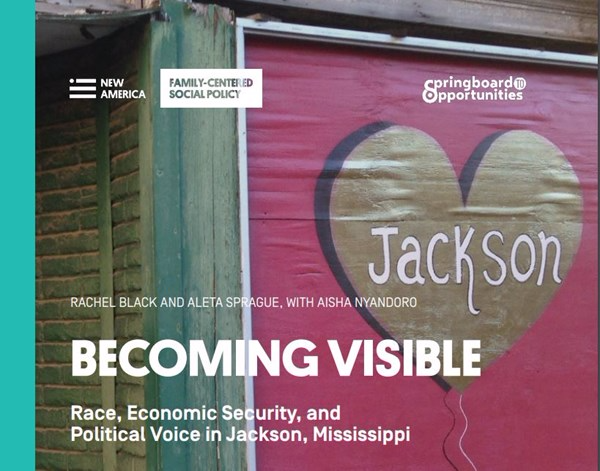
BECOMING VISIBLE
In partnership with Springboard to Opportunities, FCSP released Becoming Visible: Race, Economic Security, and Political Voice in Jackson, MS.
Informed by focus groups and interviews with women living in public housing in Jackson, Becoming Visible challenges the marginalizing, racialized narratives around people living in poverty that currently predominate policy discourse and design with the voices of real families. Through their experiences, we identify the ways in which social, economic, and political exclusion are predictable consequences of policies that consider families in poverty — especially Black families in poverty —second class citizens.
Our report calls for a new approach to making social policy that affirms the equal humanity and dignity of all people by shifting power and influence to the families and communities policy is intended to serve. Carrying this work forward, in December 2018, Springboard launched the Magnolia Mother’s Trust, one of the first guaranteed-income pilots in the country to deliver cash to its recipients.

CHILD SAVINGS ACCOUNTS
Funded by generous support from the Charles Stewart Mott Foundation, FCSP carried forward the Asset Building Program’s work on Child Savings Accounts (CSAs). Our work on CSAs stretches back to the early 2000’s, when the founding director of the Asset Building program, Ray Boshara, articulated a vision for a national, universal, automatic, and progressive system of CSAs. In the ensuing years we have been involved in developing dozens of pieces of CSA-focused legislation at the federal level, including giving input on Senator Cory Booker’s (D-NJ) American Opportunity Accounts or “Baby Bonds” legislation, which Justin King wrote about in late 2018.
We analyzed the implications of federal tax law changes to 529 college savings accounts for CSAs with partners at the Center for Social Development (CSD) and Prosperity Now (PN); and argued that states should seize the opportunity created by those changes to make 529s more inclusive and targeted to marginalized children and families.
Working in partnership with other organizations we have helped to grow the CSA movement to serve nearly 500,000 children in 34 states across the country in 2018. That impact continues to grow. In 2010, a program supported by New America, Kindergarten to College (K2C) in San Francisco, became the nation’s first municipal, automatic, and universal CSA. Then-Mayor of San Francisco and now-Governor of California, Gavin Newsom has proposed $50 million to launch additional efforts across the state.
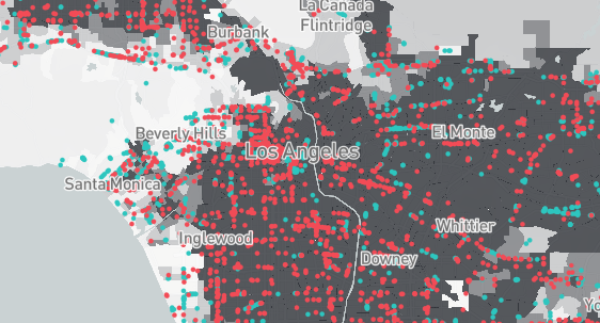
MAPPING FINANCIAL OPPORTUNITY
Working in partnership with Terri Friedline and Mat Despard, we developed Mapping Financial Opportunity (#MapFinOpp), a web platform detailing the location of every financial service provider in the United States.
Recently updated to contain a significantly larger number of alternative financial service providers (AFS), #MapFinOpp allows users to visualize the locations and concentrations of traditional financial services, AFS, and efforts to promote financial inclusion (IRS VITA sites, CDFIs, Bank On coalitions, and more) nationwide.
Mapping Financial Opportunity has proven to be a powerful research tool, The Racialized Costs of Banking, authored by Terri Friedline and Jacob Faber, suggests small banks nationwide consistently apply racially discriminatory pricing in their base level checking products. According to the research, customers in cities and towns with black, Latinx, and other non-white majorities are charged more to open and maintain checking accounts than customers in majority white areas.
This project allows researchers, advocates, and community members to gain a deeper awareness of the connection between place and financial well-being and to explore the challenges of financial inclusion and financial health with greater precision. #MapFinOppwill remain available and functional on the New America website for the foreseeable future.
ONE EVENT WE LOVED
In May 2018, FCSP and the Political Reform program joined Cornell University Professor Jamila Michener to discuss her book Fragmented Democracy: Medicaid, Federalism and Unequal Politics. Dr. Michener's research explores how public programs like Medicaid shape participants' perception of their political value. As a consequence, variation in how these programs are administered by states can either bolster or undermine democracy.
Watch our discussion with Dr. Michener, "Democracy Between the Lines," and read Dr. Michener's analysis of efforts to add work requirements to Medicaid as part of a long history of racially biased health policy in Political Reform's Polyarchy blog on Vox.
ONE ARTICLE WE LOVED
Writing in Slate, Justin King and co-author Afua Bruce from New America’s Public Interest Technology program explored the ways in which technology is reshaping delivery of the safety net (for better and for worse), and raised the possibility that this new technology could organize and give voice to marginalized Americans in unprecedented ways:
“The Trump administration is working to allow more states to impose work requirements like those in Arkansas on Medicaid and to open the door to similar rules in SNAP. Last week, Code for America launched a new website that distills input from hundreds of anonymous users and “combats myths, provides facts, and most importantly, elevates the voices of GetCalFresh users.” This new wave of tech actors isn’t just building apps…it’s also building megaphones.”
OUR FELLOWS IN ACTION
In 2017, FCSP Fellow Mia Birdsong and Professor Brittney Cooper convened social visionaries in DC and the Bay Area for conversations on the imperative to center the leadership of Black women within institutions of power and influence to achieve a society that benefits us all. Click here to watch the recording of "Beyond Respectability." In 2018, Mia interviewed Facebook co-founder Chris Hughes, Springboard to Opportunities CEO Aisha Nyandoro, and Darrick Hamilton of Ohio State University to explore the modern debate over a Universal Basic Income (UBI) and discuss ways in which the communities most deeply aware of the failures of our current economy and policy structure can have a role in defining what comes next. Watch "Fair Shot" here.
In 2018, Fellow Virginia Eubanks discussed the ways that artificial intelligence, big data, and predictive analytics are shaped by our fear of economic precarity and disdain for the poor among policymakers, activists, organizers, journalists, scholars, and technologists. Watch "Dismantling the Digital Poorhouse."
We hosted Senior Research Fellow Willie Elliott and his co-author Melinda Lewis for the launch of their second book, Making Education Work for the Poor in July 2018. With guests like Richard Reeves and Darrick Hamilton, "Making Education Work" was an intense discussion of the idea that tackling educational equity means first fixing wealth inequality.
Research Fellow Terri Friedline is pioneering new ways of exploring the geography of financial services and inequality through Mapping Financial Opportunity. In June 2018, Terri and co-author Jacob Faber wrote in the Washington Post about their research on racially discriminatory pricing practices in the banking industry, and the troubling march of bank deregulation:
“The mutually reinforcing trends of deregulation bills and rollbacks of consumer protections place communities of color at risk for discriminatory banking practices — even for the most basic of products. Worse, these coordinated trends suppress the economic power of these consumers and communities by detaining a greater share of their earnings in the same financial system that discriminates against them.”
Greg Kaufmann joined FCSP as a Fellow in September 2018 to focus on the organizing and ideas of people with low-incomes and community-based organizations; as well as poverty solutions and the elected officials who are pursuing them. In the short time since he joined us Greg has reported on the development of the Magnolia Mother’s Trust in Jackson, MS; a candidate for Congress who said, “growing up in poverty 'grounded my decision-making and framed everything I do.'”; the need to fight racism as an anti-hunger strategy; the Poor People’s Campaign across the nation and in DC; and the ease of cutting child poverty in half (if the political will exists.)
After working as a staff member in the Asset Building program, Aleta Sprague continued to play a critical role on our team as a Program Fellow with FCSP. She helped to define FCSP’s vision, explore the history of race and racism in shaping welfare policy, put a spotlight on the cynical exploitation of “waste, fraud, and abuse” claims, and push back against the movement to predicate assistance programs on so-called “work requirements.”
We're grateful to all of them, and so many other colleagues over the years, for being our partners and friends. If you like what they've done here, you can follow all of them on Twitter:
@miabirdsong
@PopTechWorks
@AssetsEducation
@TerriFriedline
@GregKaufmann
@aleta_rose
It's a privilege to be able to work in public policy. To have the opportunity to try and smooth the path for others and improve lives is special. Thanks for being a part of that experience with us.
More About the Authors

Rachel Black
Co-Director, Family-Centered Social Policy
Issues
Programs/Projects/Initiatives
Related
How Do You Weather a Short-Term Financial Crisis?

‘Give People Money’ Comes to Child Savings

Greg Kaufmann Joins Family-Centered Social Policy