Energy Security Cannot be a Zero Sum Game
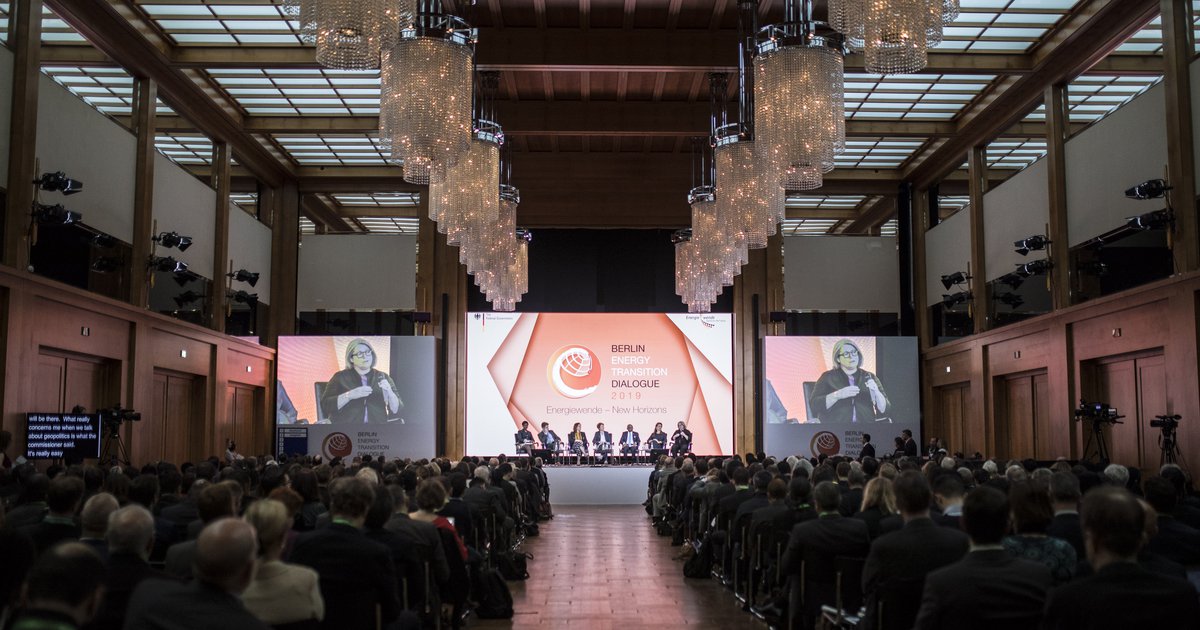
Remarks as Prepared by Sharon Burke for the Berlin Energy Transition Dialogue in Berlin, Germany on April 9, 2019
In 2016, Barack Obama, my former boss, wrote:
“If you had to choose any time in the course of human history to be alive, you’d choose this one…By almost any measure…the world is better than it was 50 years ago, 30 years ago, or even 8 years ago.”
Now, what did he mean by that? And keep in mind he wrote that right after the election of Donald Trump.
He was looking at the bigger picture — the biggest picture of all. More children are going to school than ever before today. Fewer people are suffering from chronic hunger than at any time in history. Diseases that used to kill so many, polio and smallpox, have been eradicated.
Humanity is flourishing.
We’ve gone from one billion people in 1800, with almost everyone living in extreme poverty, to 7 billion today, with less than 10 percent in extreme poverty. That’s still too many — there are too many people who don’t live as well as they should, but some 200,000 people are being lifted out of poverty around the world every day.
It’s amazing. And it’s significant.
But there’s a dark side to all of this progress. The hydrocarbons that drove all of that growth — that industrial revolution — have exacted a cost, and the consequences are piling up. The climate is changing, extinctions are at an all time high. So, there’s a key question today: is this spectacular moment in human history just that, a moment? Or is it a trend?
That depends a great deal on the success of the energy transition, whether the world can replace fossil fuels with clean energy. I know this is a discussion about geopolitics, and it’s very interesting to focus on who’s up and who’s down, who are the winners and the losers. But I think it’s important to keep in mind what the bottom line of this transition is: to sustain and spread the advancement in human lives. To continue the trend.
This effort cannot be a zero sum game, where some countries have to fall, or others do not get to rise. Everyone has to benefit from this transition. And it’s important that we not repeat the mistakes of the past by swapping one resource curse for another — lithium for oil, for example. We have a chance to do this right.
Now, the United States government has been talking of late in terms of great power competition. This current president notwithstanding, competition doesn’t have to be a bad thing. We don’t have to fear it. It can spur investment, innovation, and cooperation. It can boost new producers, create new markets, forge new partnerships, and spread new technologies to people who don’t have them.
In fact, competition is essential for the energy transition — as I said, it spurs innovation, and that’s what we need. I know renewables have been growing quickly, and there are reasons to be hopeful — and many reasons to be determined. The rhetoric on clean energy out of my national government is not good, but keep your eyes on the subnational players. California, for example — my home state — has the 5th largest economy in the world, just behind Germany and ahead of the United Kingdom. And California has a target of 100% clean energy for electricity by 2045. That state will be an engine of growth for the United States, no matter who sits in the White House.
At the same time, as we heard this morning from the International Energy Agency, fossil fuel use has also continued to grow worldwide. The scale of what we have to replace is enormous. We have to be realistic about that, especially if we want to sustain and improve the quality of life for all human beings. We must have more innovation: we need solar with higher conversion efficiencies, better energy storage, cybersecurity for smart grids, and entirely new ways of consuming energy — an Information Age to displace the Industrial Age. Competition will help us.
What worries me is another kind of competition — competition that hyperfocuses on military means.
For the United States, our biggest government investment is in our people — 60 percent of the national budget is in social programs, such as social security and medical benefits. But in our other discretionary funds, we invest far more in our military than we do in other elements of national power and prosperity — about a trillion dollars, counting the defense budget, veterans, and nuclear programs. We put so much less into diplomacy, trade, development, and research. All the things we need for the energy transition. And while we are more transparent about those military investments than some other countries, we are not alone in putting this disproportionate emphasis on advanced weaponry.
Tell me where that ends?
I’m a pragmatist, a realist, and I know that humans have been fighting since we could first throw rocks at each other. But the stakes are so very high today. If this great power competition takes the form of armed violence — no one will win. We need to plan today for peace and coexistence just as much as we plan for war. This can’t be a zero sum game.
As former President Obama wrote in that same article: “That’s how we will overcome the challenges we face: by unleashing the power ofall of us forall of us. Not just for those of us who are fortunate, but for everybody.”
Thank you so much.
More About the Author
Related
Climate Security: Building a Community of Practice

Climate Change, Peace and Security, and the UN Group of Friends

Infrequently Asked Questions