Amy Laitinen
Senior Director, Higher Education


This blog post is largely excerpted from a recent New America report, The Bermuda Triad: Where Accountability Goes to Die.
In 1992, a Senate subcommittee led by Sen. Sam Nunn (D-GA) and investigating waste, fraud, and abuse in the postsecondary financial aid programs reported that the program integrity triad–the state authorizers, accreditors, and Department of Education with shared responsibility for overseeing the thousands of colleges in the U.S. higher education system–”provides little or no assurance that schools are educating students efficiently and effectively.”
Unfortunately, more than a quarter-century later, the situation has scarcely improved. At thousands of poor- and under-performing colleges, millions of students are paying–and often borrowing–a lot, frequently without knowing their schools are underperforming until it’s too late. Nationally, only about 42 percent of students complete a four-year degree in four years—with rates that are much lower for Black (22 percent) and Hispanic (33 percent) students—and fewer than one in three complete a certificate or associate degree within one-and-a-half times the length of time it should take them. At hundreds of colleges, alumni who attended school using federal aid leave with typical earnings of less than $25,000, with many well below the average earnings of a worker with only a high school diploma. Over a million borrowers each year fall behind and default on their loans for the first time. And in recent years, tens of thousands of students have seen their colleges close in the blink of an eye, with no warning and few options.
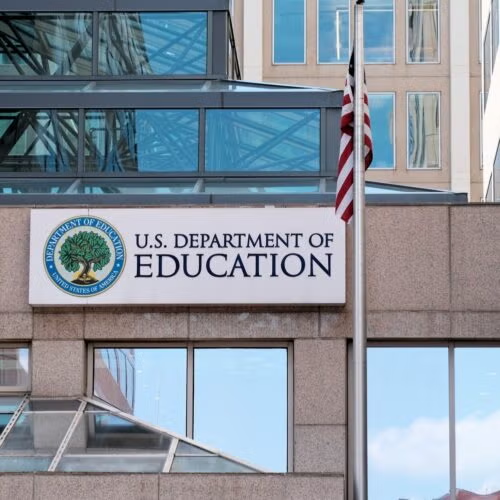
In such a diffuse, varied system, gatekeeping responsibilities are not simple. So Congress cobbled together a “program integrity triad” to share the responsibilities, pulling in existing entities—designed in a different time and for different purposes—to fill that role as it expanded federal dollars to more colleges. In general, accrediting agencies are approved by the Education Department to bear responsibility for the academic quality of the colleges they accredit; the states are tasked with consumer protection; and the federal government, via the U.S. Department of Education, certifies institutions to be eligible for taxpayer-financed financial aid and oversees their administration of those funds. This system has scarcely evolved to address massive increases in the federal investment in higher education; huge increases in the number of Pell Grant recipients and student loan borrowers; and the development of new institutions, education providers, and delivery models entering the system.
Too often, the system of shared accountability devolves into a game of hot potato, with no one member of the triad willing to take serious action against an institution of higher education that falls short until other members of the triad have stepped up. With potentially severe consequences for a college—and its students—each member of the triad has a tendency to wait several beats too long before enforcing any severe action against a college, often no matter how poor the institution. And each piece of the triad is guilty of seeing institutions, not students and taxpayers, as the client. This imbues regulatory capture, in which regulators feel beholden to the interests of the industry they regulate, at every level of oversight.
That’s why, this week, we published a new report exploring the recent history of each leg of the program integrity triad, and detailing recommendations to strengthen and improve the functioning of the system of accountability for higher education. Check out the full report here to learn stories like former Education Secretary Margaret Spellings’ failed attempt to ask accreditors to look at outcomes; the rise and fall and rise and fall of Charlotte School of Law; and how the higher education lobby has fought to shut down accountability across all three legs of the triad. And check out our recommendations below:
→ SUMMARY OF RECOMMENDATIONS
Accreditors
States
U.S. Department of Education
Enjoy what you read? Subscribe to our newsletter to receive updates on what’s new in Education Policy!
Senior Director, Higher Education